LIMS Overview and Governance
Provides the authoritative introduction to Malawi's Laboratory Information Management System, including its purpose, vision, objectives, scope, evolution, governance, stakeholders, and strategic direction. This is the recommended starting point for anyone unfamiliar with the Malawi LIMS ecosystem.
- About Malawi LIMS
- 1. What is LIMS
- 2. Purpose of the LIMS
- 3. Vision
- 4. Objectives
- 5. Scope
- 6. Supported Laboratory Disciplines
- 7. Key Stakeholders
- 8. Brief History of LIMS
- 9. LIMS at a Glance
- Governance
- LIMS Architecture
About Malawi LIMS
This chapter looks at LIMS overview, Purpose, Vision, Objectives, Scope, Stakeholders, and history.
The Malawi Laboratory Information Management System is not simply a software application used by laboratories. It is a national digital health information ecosystem connecting laboratory workflows, laboratory equipment, facility systems, national information systems, dashboards, and health programs.
Its fundamental purpose is to ensure that laboratory information is captured accurately, processed efficiently, transmitted securely, and transformed into actionable information for patient care, laboratory management, and public health decision-making.
The continued evolution of iBLIS, NLIMS, laboratory analyzer interfaces, ART/EMR integration, and national dashboards provides the foundation for an increasingly integrated and interoperable national laboratory information ecosystem.
1. What is LIMS
The Laboratory Information Management System (LIMS) is a national digital platform designed to support and manage laboratory operations throughout the complete laboratory testing lifecycle.
The system supports the movement of laboratory information from the point at which a patient requires a laboratory investigation through ordering, sample collection, sample processing, testing, result verification, authorization, reporting, and synchronization with national health information systems.
In Malawi, the LIMS ecosystem consists primarily of iBLIS at the facility level and the National Laboratory Information Management System (NLIMS) at the national level.
At the facility level, iBLIS supports day-to-day laboratory operations, including patient registration, laboratory orders, sample tracking, barcode generation, analyzer interfacing, result entry, result validation, printing, and local reporting.
At the national level, NLIMS receives synchronized laboratory information from participating laboratories and provides national aggregation, reporting, dashboard visualization, analytics, and monitoring of laboratory performance.
The overall information flow can be represented as:
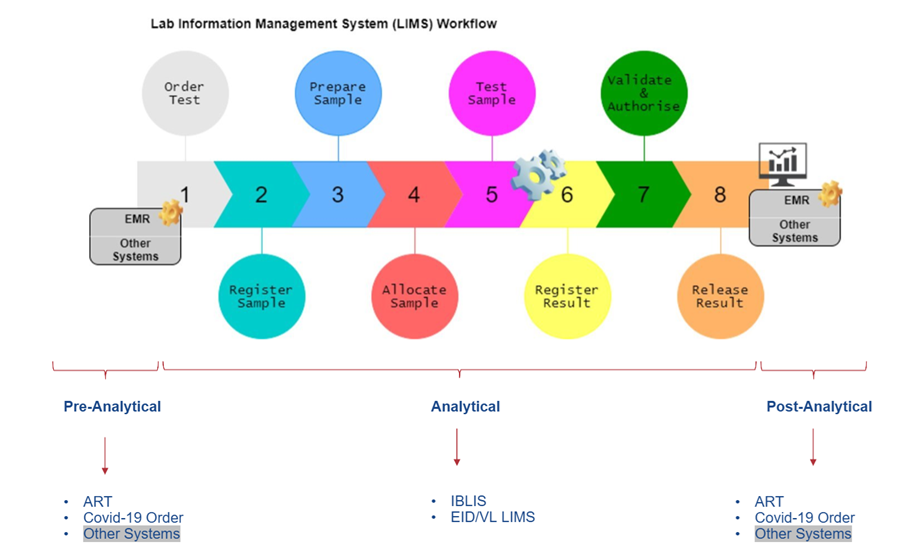
This architecture enables laboratory information to move from individual laboratory processes into national-level information systems for patient management, monitoring, planning, and public health decision-making.
2. Purpose of the LIMS
2. Purpose of the LIMS
The primary purpose of the Malawi LIMS is to digitize, standardize, and improve laboratory operations while ensuring that reliable laboratory information is available to support patient management and public health decision-making.
The system is designed to manage the laboratory testing lifecycle from patient registration through sample collection, testing, result validation, reporting, and synchronization with national health information systems.
The LIMS serves several important purposes.
2.1 Digitization of Laboratory Processes
The LIMS replaces or reduces manual laboratory processes by providing electronic workflows for activities such as:
- Patient registration
- Laboratory test ordering
- Sample collection
- Barcode generation
- Sample reception
- Sample tracking
- Result entry
- Result verification
- Result authorization
- Result printing
- Reporting
- Data synchronization
Digitization helps laboratories manage information more efficiently and provides greater visibility of laboratory activities.
2.2 Improved Turnaround Time
The LIMS is intended to reduce the time between sample collection, testing, result authorization and availability of results to clinicians and patients.
The existing implementation has demonstrated significant improvement in Viral Load turnaround time, with documented reduction from approximately 70 days to 13 days through workflow automation and interoperability.
2.3 Reduction of Manual and Transcription Errors
Integration between LIMS and laboratory analyzers reduces the need for manual transcription of laboratory results.
More than 80% of supported laboratory analyzers have been interfaced, helping reduce manual data entry and associated transcription errors.
2.4 Improved Laboratory Quality
The LIMS provides functionality for quality control, result verification, authorization, and reporting.
It supports:
- Internal quality control
- External quality control
- QC reporting
- QC result printing
- Result verification
- Result authorization
- Audit trails
2.5 Interoperability
The LIMS provides an electronic information exchange mechanism between laboratory systems and other health information systems.
Integration with ART/EMR enables electronic laboratory ordering and electronic delivery of laboratory results.
The system also supports API-based interoperability and integration with national systems such as EID/VL LIMS and external partners.
2.6 National Laboratory Analytics
The national LIMS environment provides aggregated information for monitoring laboratory performance.
National dashboards can provide information relating to:
- Facility
- District
- Region
- Synchronization status
- Laboratory workload
- Turnaround time
- Facility performance
- Machine utilization
- Sample rejection
- Reporting completeness
3. Vision
The vision of the Malawi LIMS is:
"To provide a fully integrated, interoperable, and sustainable national laboratory information ecosystem that improves patient care and public health decision-making."
This vision positions LIMS as more than a standalone laboratory application. It establishes the system as part of a broader national digital health ecosystem in which laboratory information can be securely exchanged and used at facility, district, national, and program levels.
The vision is built around four important principles:
Integration
Laboratory systems should be connected to relevant health information systems rather than operating as isolated applications.
Interoperability
Systems should be able to exchange meaningful laboratory information using appropriate technologies, APIs and interoperability standards.
Sustainability
The national laboratory information ecosystem should be maintainable and sustainable over the long term.
Improved Decision-Making
Laboratory data should be transformed into useful information that supports patient care, program management, and public health decisions.
4. Objectives
The Malawi LIMS aims to achieve the following objectives.
4.1 Digitize Laboratory Workflows
To replace manual laboratory processes with standardized electronic workflows covering the laboratory testing lifecycle.
4.2 Improve Turnaround Time
To reduce the time required to process samples and make laboratory results available to clinicians and other authorized users.
4.3 Eliminate or Reduce Transcription Errors
To minimize manual transcription by using electronic workflows, barcode identification and analyzer interfaces.
4.4 Improve Laboratory Quality
To strengthen laboratory quality management through result verification, authorization, quality control, and auditability.
4.5 Interface Laboratory Analyzers
To connect laboratory analyzers to LIMS so that laboratory results can be electronically transferred into the system.
The current implementation has interfaced more than 80% of supported laboratory analyzers.
4.6 Integrate with National Health Systems
To enable laboratory information to be electronically exchanged with systems such as ART/EMR and NLIMS.
4.7 Improve Stock Management
To support laboratory inventory management through stock receiving, issuing, consumption monitoring, and reorder alerts.
4.8 Support Disease Surveillance
To provide reliable laboratory information that can contribute to disease surveillance, program monitoring, and public health decision-making.
4.9 Provide National Laboratory Analytics
To aggregate laboratory information and provide national-level reporting, dashboards, and analytics.
4.10 Improve Patient Management
To ensure that laboratory results are available electronically and efficiently to support appropriate patient management.
5. Scope
The Malawi LIMS covers the management and exchange of information associated with laboratory services from the point of laboratory request through testing, result management and reporting.
The scope encompasses both facility-level laboratory operations and national-level laboratory information management and analytics.
5.1 Facility-Level Scope
At the facility level, iBLIS supports:
- Patient registration
- Patient search
- Patient demographics
- Laboratory order management
- Priority samples
- Referral samples
- Test ordering
- Sample collection
- Barcode generation and printing
- Sample reception
- Sample tracking
- Sample storage
- Referral tracking
- Manual result entry
- Automated analyzer result import
- Result verification
- Result authorization
- Result printing
- Quality control
- Inventory management
- Local reporting
5.2 National-Level Scope
At the national level, NLIMS supports:
- Laboratory data aggregation
- National reporting
- Dashboard visualization
- National analytics
- Monitoring laboratory performance
- Monitoring synchronization
- Integration with external systems
- Programme and disease reporting
5.3 Integration Scope
The LIMS ecosystem interfaces with:
- ART/EMR systems
- NLIMS
- Laboratory analyzers
- External systems through APIs
The current documentation identifies REST APIs and data formats, including JSON, CSV, XML, and HL7 where applicable.
5.4 Infrastructure Scope
The LIMS environment includes the supporting infrastructure required for laboratory information management, including:
- Servers
- Client computers
- Barcode printers
- A4 printers
- Barcode scanners
- Power backup systems
- LAN infrastructure
- VPN connectivity
- Laboratory analyzers
5.5 Geographic Scope
The system is implemented as a national laboratory information ecosystem supporting laboratory services across Malawi.
The current implementation includes iBLIS deployment across most district hospital laboratories and integration with ART/EMR across approximately 272 facilities.
6. Supported Laboratory Disciplines
The Malawi LIMS documentation identifies the following laboratory disciplines and services as supported:
- Clinical Chemistry
- Hematology
- Microbiology
- Blood Bank
- Molecular Diagnostics
- HIV Viral Load
- Early Infant Diagnosis (EID)
- Tuberculosis (TB)
- Malaria
- COVID-19
- General Laboratory Services
The breadth of supported disciplines demonstrates that the LIMS is intended to serve as a national laboratory information ecosystem, rather than a system dedicated to a single disease programme or laboratory service
7. Key Stakeholders
The Malawi LIMS is a multi-stakeholder national health information system. Its successful operation depends on collaboration between government, laboratories, technical teams, implementing partners and development partners.
The current LIMS documentation identifies the following major stakeholder groups.
7.1 Ministry of Health
The Ministry of Health is a central stakeholder in the national LIMS ecosystem.
The Ministry has an interest in:
- National laboratory information
- Health system planning
- Laboratory performance
- Disease surveillance
- National reporting
- Digital health interoperability
- System sustainability
- Policy and strategic direction
7.2 National Reference Laboratories
National reference laboratories contribute to the implementation and use of LIMS for laboratory testing, quality management, specialized testing, national surveillance, and technical laboratory functions.
7.3 District Health Offices
District Health Offices are important stakeholders in the implementation and monitoring of laboratory services at district level.
They benefit from information on:
- Laboratory performance
- Testing volumes
- Result availability
- Turnaround time
- Facility performance
- Reporting completeness
7.4 Laboratory Personnel
Laboratory personnel are the primary operational users of facility-level LIMS functionality.
This includes personnel involved in:
- Patient and sample processing
- Laboratory testing
- Result entry
- Result verification
- Result authorization
- Quality control
- Laboratory management
7.5 Software Developers
Developers are responsible for designing, developing, maintaining, and enhancing the software components of the LIMS ecosystem.
Their responsibilities may include:
- Application development
- Database development
- API development
- System integration
- Analyzer interfaces
- Bug fixing
- Testing
- Deployment
- System enhancements
7.6 Quality Assurance Teams
Quality assurance teams contribute to ensuring that laboratory processes and the information system support appropriate quality standards.
Their involvement includes areas such as:
- Quality control
- Data quality
- Process monitoring
- System validation
- Testing
- Performance monitoring
7.7 Implementing Partners
Implementing partners contribute technical, operational, and program support to the national LIMS ecosystem.
Their role may include:
- System implementation
- Technical assistance
- Training
- Infrastructure support
- Software development
- Integration
- Monitoring and evaluation
7.8 Donor Organizations
Donor organizations provide financial and technical support that contributes to the implementation, expansion, and sustainability of laboratory information systems. CDC is the major donor for the LIMS
7.9 System Administrators
System administrators maintain the operational configuration of LIMS.
The current documentation identifies administrator functions, including management of:
- Users
- Roles
- Facilities
- Test catalogues
- Machines
- Printers
- Synchronization
- Reference data
8. Brief History of LIMS
8.1 Introduction
The current LIMS documentation provides information about the present national LIMS environment and major implementation milestones, but it does not provide a complete chronological history of LIMS development in Malawi.
Therefore, this section should be treated as a high-level evolution of the documented LIMS environment, rather than a definitive historical account.
A comprehensive historical section should eventually be developed from program records, previous system documentation, project reports, implementation reports, and release histories.
8.2 Evolution Toward a National LIMS Ecosystem
The development of LIMS in Malawi can be understood as an evolution from individual laboratory processes and specialized laboratory information systems toward an integrated national laboratory information ecosystem.
The current documentation demonstrates the following major stages of development.
Stage 1 — Digitization of Laboratory Processes
The introduction and expansion of laboratory information systems enabled laboratory processes that were previously dependent on manual procedures to be digitized.
The objective was to improve efficiency, reduce manual processes, strengthen quality assurance and improve access to laboratory information.
Stage 2 — Development and Expansion of iBLIS
iBLIS became the facility-level laboratory information system supporting day-to-day laboratory operations.
Its functionality includes:
- Patient management
- Order management
- Sample management
- Barcode management
- Result management
- Analyzer interfacing
- Quality control
- Inventory management
- Reporting
The system was subsequently expanded to additional laboratories, including district hospital laboratories.
Stage 3 — Establishment of National-Level Aggregation
The development and implementation of NLIMS introduced a national-level aggregation and analytics layer.
Laboratory information generated at participating facilities could be synchronized into NLIMS for:
- National reporting
- Data aggregation
- Dashboards
- Analytics
- Laboratory performance monitoring
- Integration with external systems
Stage 4 — Integration with ART/EMR
A major milestone was the integration of LIMS with ART/EMR systems.
The integration enabled the following:
- Electronic laboratory ordering
- Electronic result delivery
- Improved interoperability between clinical and laboratory systems
Currently the integration with ART/EMR is across approximately 272 facilities.
Stage 5 — Expansion of Analyzer Interfacing
Laboratory analyzer interfacing became an important part of the national LIMS architecture.
More than 80% of supported laboratory analyzers have been interfaced, reducing manual result entry and transcription.
Machine interfaces have also been deployed across 35 priority laboratories.
Stage 6 — Development of National Dashboards
National dashboards were developed to provide visibility into laboratory operations and synchronization.
Current dashboard indicators include:
- Region
- District
- Sending facility
- Clinic frequency
- Last synchronization date
- Days since last synchronization
- ART/EMR status
- Facility reachability
- Last order received
- Possible synchronization issues
Additional analytics include:
- Test volumes
- Turnaround time
- Facility performance
- Sample rejection trends
- Reporting completeness
Stage 7 — Improved Laboratory Turnaround Time
The implementation of electronic laboratory workflows and interoperability contributed to significant improvements in Viral Load result turnaround time.
The current documentation reports a reduction from approximately 70 days to 13 days.
This represents an important example of the potential impact of integrated laboratory information management.
Stage 8 — Expansion of Laboratory Functionality
The LIMS has continued to expand beyond basic laboratory information management.
Documented enhancements include:
- Blood bank crossmatch workflows
- Microbiology reporting
- Malaria reporting
- Quality control reporting
- Enhanced metadata collection
- Expanded laboratory dashboards
- API-driven interoperability
- Addition of the Test Catalog to maintain uniformity in test naming across facilities
Stage 9 — Towards an Integrated and Sustainable National Ecosystem
The current direction of the LIMS ecosystem is toward greater interoperability, sustainability, and national ownership.
The future roadmap includes:
- Expanded interoperability
- HL7 FHIR support
- Improved synchronization
- Enhanced laboratory performance dashboards
- Mobile-friendly workflows
- Advanced inventory management
- Additional analyzer integrations
- AI-assisted quality assurance and anomaly detection
- Strengthened cybersecurity
This direction represents a transition from individual laboratory applications toward a more integrated national laboratory information ecosystem.
9. LIMS at a Glance
The Malawi LIMS can therefore be summarized as follows:
|
Area |
Description |
|
What is LIMS? |
A national digital platform supporting the laboratory testing lifecycle |
|
Facility System |
iBLIS |
|
National System |
NLIMS |
|
Primary Purpose |
Digitize laboratory operations and improve laboratory information management |
|
Key Benefit |
Faster, more reliable and more accessible laboratory information |
|
Major Integration |
ART/EMR |
|
Analyzer Integration |
More than 80% of supported analyzers |
|
ART/EMR Integration |
Approximately 272 facilities |
|
Key Analytics |
TAT, test volumes, facility performance, machine utilization, sample rejection and reporting completeness |
|
Key Users |
Laboratory personnel, managers, administrators, data managers and technical teams |
|
National Stakeholder |
Ministry of Health |
|
Strategic Direction |
Integrated, interoperable and sustainable national laboratory information ecosystem |