PEPFAR REPORTS
The main difference between PEPFAR reports and MoH reports is the calculation of clients that have defaulted; for PEPFAR a client that has defaulted is calculated as; 30 days after running out of medication.
TX_NEW
Number of Adults and Children Newly Enrolled on Antiretroviral Therapy (ART). This report provides the number of adults and children who were newly enrolled on Antiretroviral Therapy (ART) during the reporting period. It includes patients who started ART for the first time at the facility. The report is disaggregated by age and sex and further categorized based on CD4 count at the time of ART initiation. Reporting indicators include:
▪ Tx new CD4 < 200: Newly initiated clients with CD4 results less than 200
▪ Tx new CD4 >= 200: Newly initiated clients with CD4 results equal to or greater than 200
▪ Tx new CD4 Unknown: Newly initiated clients with CD4 results not done
▪ Transfer-ins: Patients who initiated ART at another facility but were newly enrolled at the reporting facility during the reporting period.
Table 1: TX_NEW report template
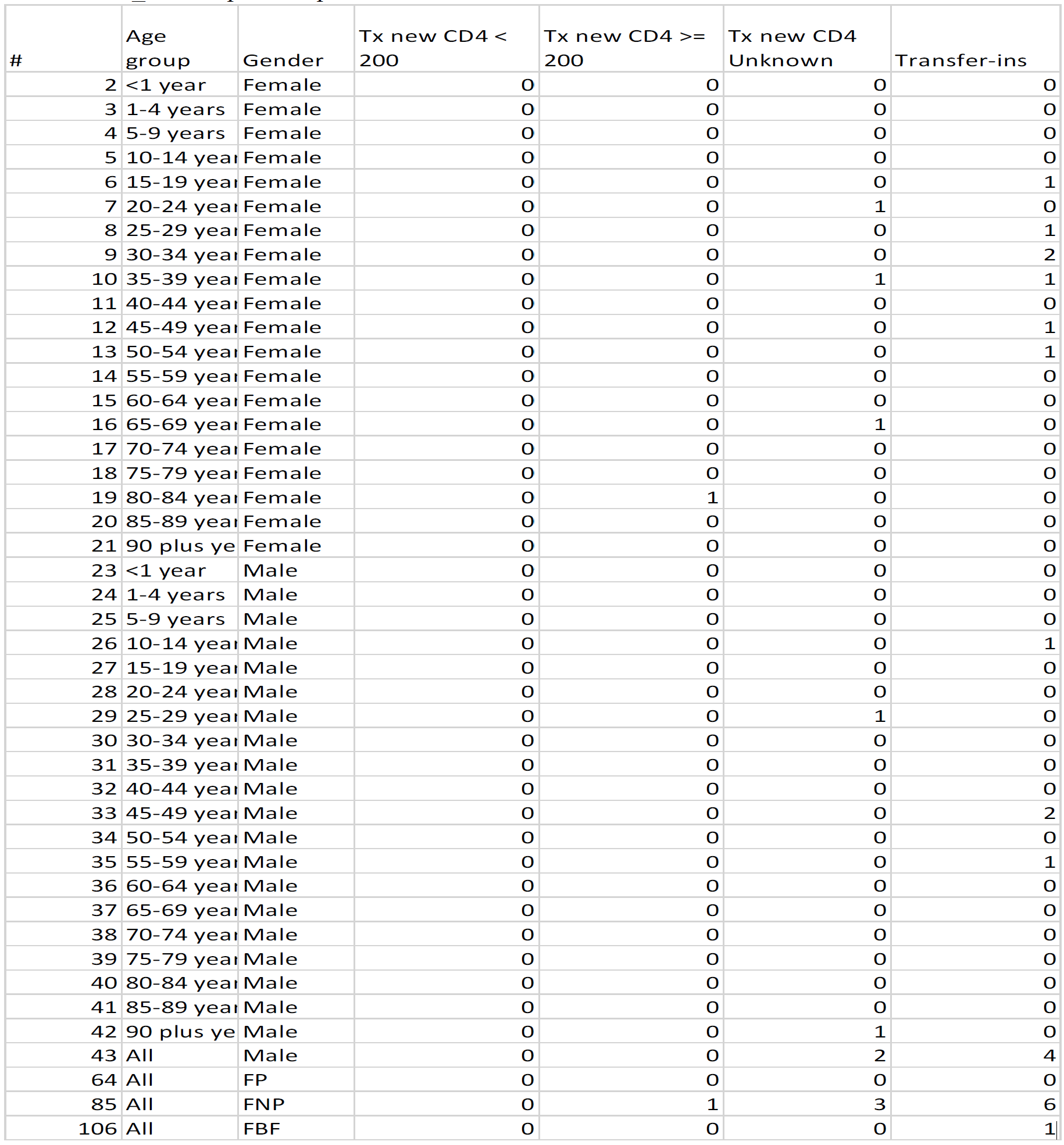
EMR Calculation: The EMR system calculates this indicator as follows: Identify all patients with an ART start date within the reporting period, confirm that the ART initiation is the first recorded ART start for the patient, retrieve the patient’s age at ART start and categorize into the defined CD4 results (if available).
TX_RTT
Number of ART patients who experienced an interruption in treatment (IIT) during any previous reporting period, who successfully restarted ARVs within the reporting period and remained on treatment until the end of the reporting period. TX_RTT counts those individuals who fulfill all of the following:
▪ Initiated ART prior to the start of the reporting period.
▪ Were not on treatment at the beginning of the reporting period after experiencing an interruption in treatment (i.e., more than 30 days since the last expected clinical contact).
▪ Restarted ARVs during the reporting period.
▪ Remained on treatment at the end of the reporting period.
This indicator helps programs track the effectiveness of patient tracing, retention strategies, and re-engagement efforts for individuals who previously interrupted ART.
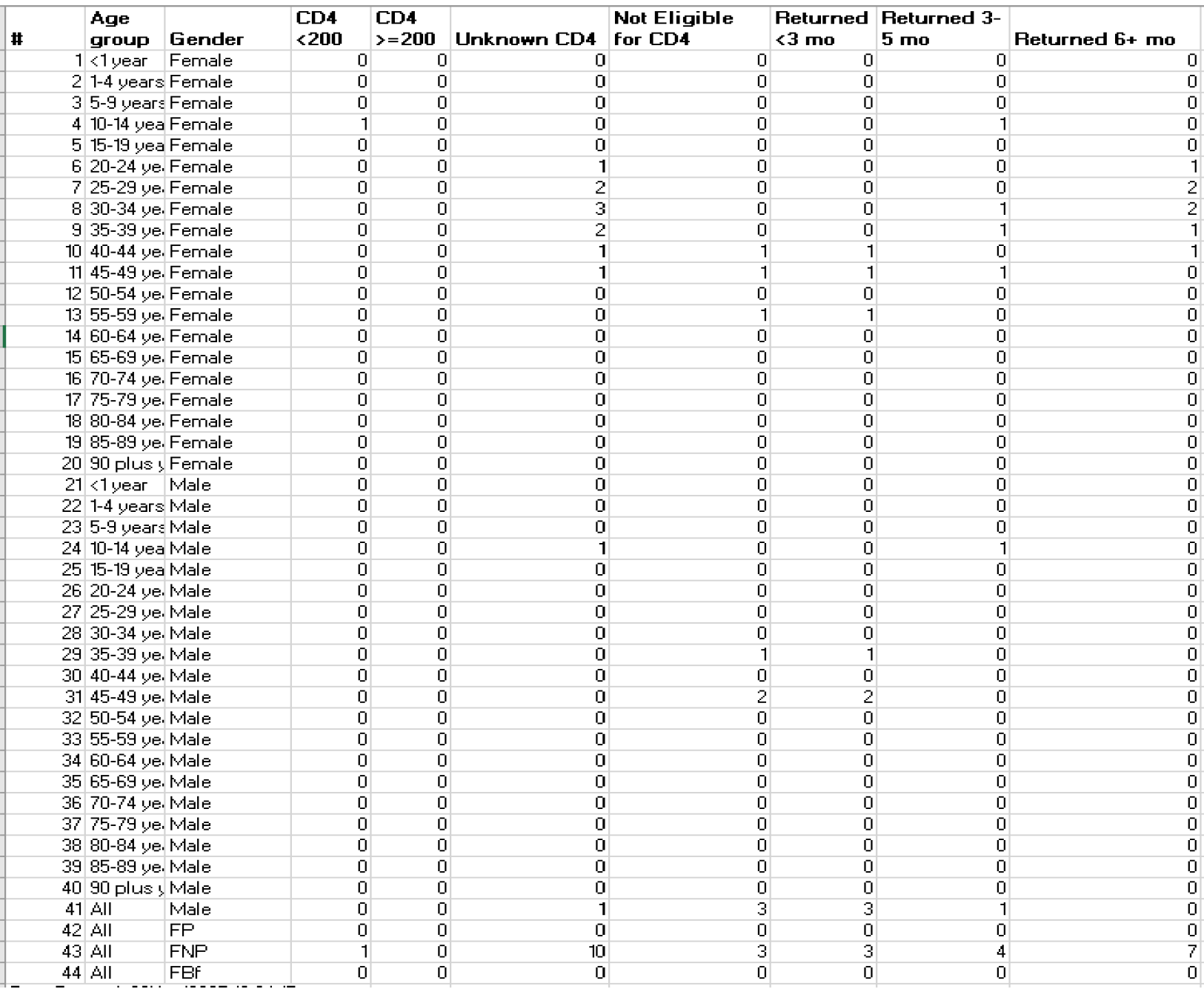
♦UPDATE TO TX_RTT: Added a disaggregate on duration of interruption in treatment and CD4 results at point of restarting ART in the report. The following are the reporting indicators disaggregated by age and sex:
▪ CD4 <200: Number of ART patients who restarted treatment during the reporting period and had a CD4 count result of less than 200.
▪ CD4 >=200: Number of ART patients who restarted treatment during the reporting period and had a CD4 count result of 200 or higher at or near the time of ART restart.
▪ Unknown CD4: Number of ART patients who restarted treatment during the reporting period without a recorded CD4 test result at the time of ART restart.
▪ Not Eligible for CD4: Number of ART patients who restarted treatment during the reporting period but were not eligible for a CD4 test according to national HIV treatment guidelines.
▪ Returned <3 months: Number of ART patients who restarted treatment during the reporting period within less than three months after experiencing an interruption in treatment.
▪ Returned 3-5 months: Number of ART patients who restarted treatment during the reporting period between three and five months after experiencing an interruption in treatment.
▪ Returned 6+ months: Number of ART patients who restarted treatment during the reporting period six months or more after experiencing an interruption in treatment.
Table 2: TX_RTT Report
TX_ML
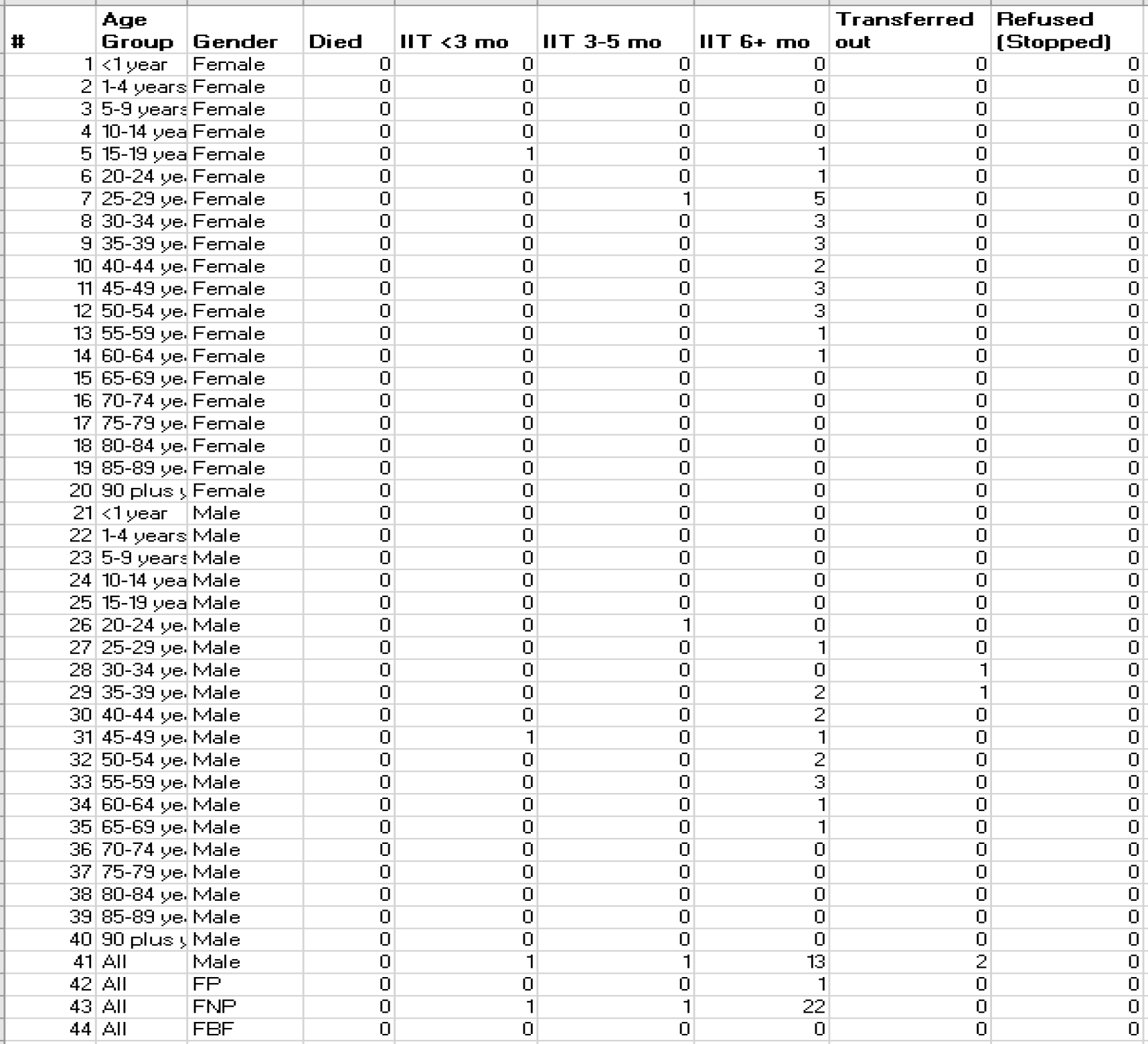
Number of ART patients (who were on ART at the beginning of the quarterly reporting period or initiated treatment during the reporting period) and then had no clinical contact since their last expected contact.
The outcomes are defined as not currently on ART at the facility if the patient:
• Died
• Interruption in treatment (IIT)
• On treatment for <3 months when experienced IIT
• On treatment for 3-5 months when experienced IIT
• On treatment for 6+ months when experienced IIT
• Transferred out
• Refused (stopped) treatment
Included in the classification of IIT are the following: patients for whom tracing is not attempted, and patients for whom tracing is attempted but unsuccessful or for whom status cannot otherwise be determined (i.e., patient may have died or may have silently transferred, but status is unknown). Patients should also be reported as IIT if they have been traced and scheduled to return after the end of the reporting period (in other words, they have not returned yet). A facility may wish to further distinguish these classifications, but they are not required for MER reporting.
Table 3: TX_ML Report
♦EMR calculations: All clients within the HIV program that were on ART at the start of the reporting period and clients that enrolled in the reporting period; are not on treatment by the end of the reporting period.
Step-by-step EMR Calculation description:
a) Select all clients that were registered in the HIV program before the start of the reporting period and they are Alive and on treatment. For example, if the reporting period is 1st January 2020 to 31st March 2020, then the start date is 1st January 2020.
b) From the previous step, the systems will add all new clients enrolled in the reporting period and were Alive and on treatment after being enrolled. For example, if the reporting period is 1st January 2020 to 31st March 2020, then all clients that were enrolled between the stated dates.
c) After selecting all Alive on treatment clients, the EMR will loop through each client checking the client’s outcome status at the end of the reporting period. If the outcome is Alive on treatment, then that client will be removed from the list.
d) The remaining clients (clients that are not in care) left from the loop (previous step), the system will classify them in their appropriate age groups using the cohort age group function (see Figure 1: Cohort disaggregated age group function) and their outcome status as of the end of reporting period.
TB_PREV
Proportion of ART patients who started on a standard course of TB Preventive Treatment (TPT) in the previous reporting period who completed therapy by the end of the reporting period.
Numerator: Among those who started a course of TPT in the previous reporting period, the number that completed a full course of therapy (for continuous IPT programs, this includes the patients who have completed the first 6 months of isoniazid preventive therapy (IPT), or any other standard course of TPT such as 3 months of weekly isoniazid and rifapentine, or 3-HP).
Denominator: Number of patients who were initiated on any course of TPT during the previous reporting period
Disaggregates on the timing of ART and age/sex breakdowns will allow programs to monitor those who are newly starting ART, an important focal population in all countries and in particular in countries that have already provided TPT for many of their PLHIV in care.
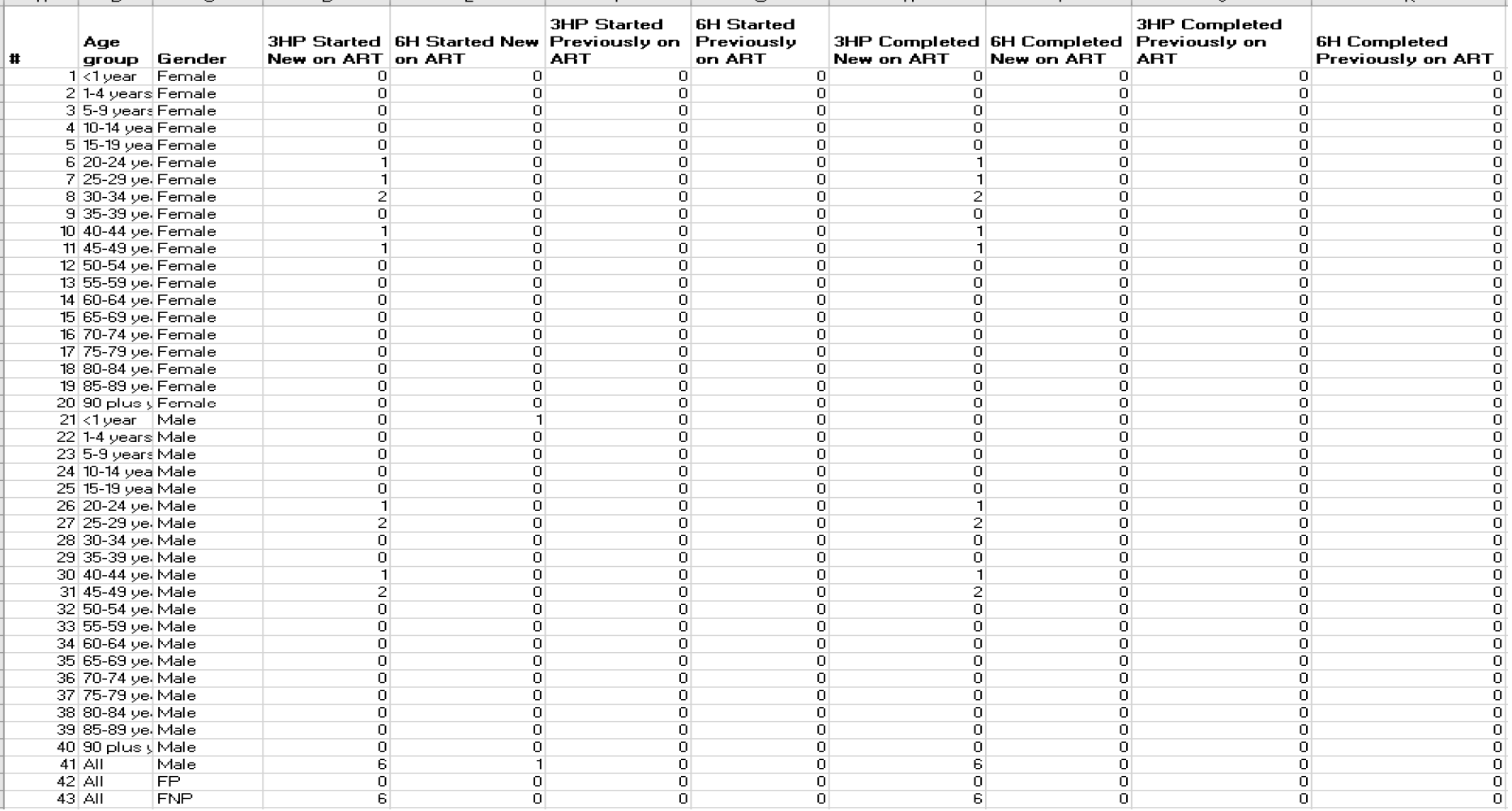
This report comprises two sub-reports, the first is on clients who started INH in the 180 days period prior to the reporting period and the second is on clients who started 3HP prior to the reporting period. Besides the expected Age group and Gender disaggregates, the clients are further classified in two main categories; New on ART and Previously on ART.
• New on ART are individuals initiated TPT within 6 months of being enrolled on ART and
• Previously on ART are individuals initiated TPT at least 6 months (or longer) after being enrolled on ART
Table 4: TB_PREV Report
For the system or report to classify a client as completed TPT, the client has to accumulate / consumed a total of 168 or more pills of INH between their first INH dispensations to the end of the reporting period or the client has to complete 3 months’ worth of 3HP (3HP course is not defined by number of pills taken because the dosages for the drug vary by weight, so looking at the prescription period is much safer). For the system or report to classify a client as completed TPT, the client has to accumulate / consumed a total of 168 or more pills of INH between their first INH dispensations to the end of the reporting period. For example, let us say we have 200 clients that has started INH on the 1st October 2019 to 31st March 2020 and had monthly INH follow-up visits on; among these 200 clients, 50 were newly on ART and 150 were previously on ART.
Visit date Drugs Given
1st October 2019 INH 30 pills
1st November 2019 INH 30 pills
1st December 2019 INH 30 pills
1st January 2020 INH 30 pills
1st February 2020 INH 30 pills
1st March 2020 INH 30 pills
If reporting for Q4, 2021 (April to September 2021), the system and the report is focusing on clients that started TPT in the Previous reporting period (October to March). For example, if a client started 6H in November 2020, they will complete TPT in April 2021 (after 6 months) if they do not miss any dosses or clinical visits for 6 months.
If a client starts 3HP in December 2020, they should complete TPT in February 2021 (After 3 months) if they do not miss any dosses or clinical visits for 3 months. The report sums up the accumulated number of prescription days for the drug and checks whether this adds up to 90 days or more.
TX PVLS (VL COVERAGE)
Percentage of ART patients with a suppressed viral load (VL) result (<1000 copies/ml) documented in the medical or laboratory records/laboratory information systems (LIS) within the past 12 months.
Numerator: Number of ART patients with suppressed VL results (<1,000 copies/ml) documented in the medical or laboratory records/LIS within the past 12 months.
Denominator: Number of ART patients with a VL result documented in the medical or laboratory records/LIS within the past 12 months.
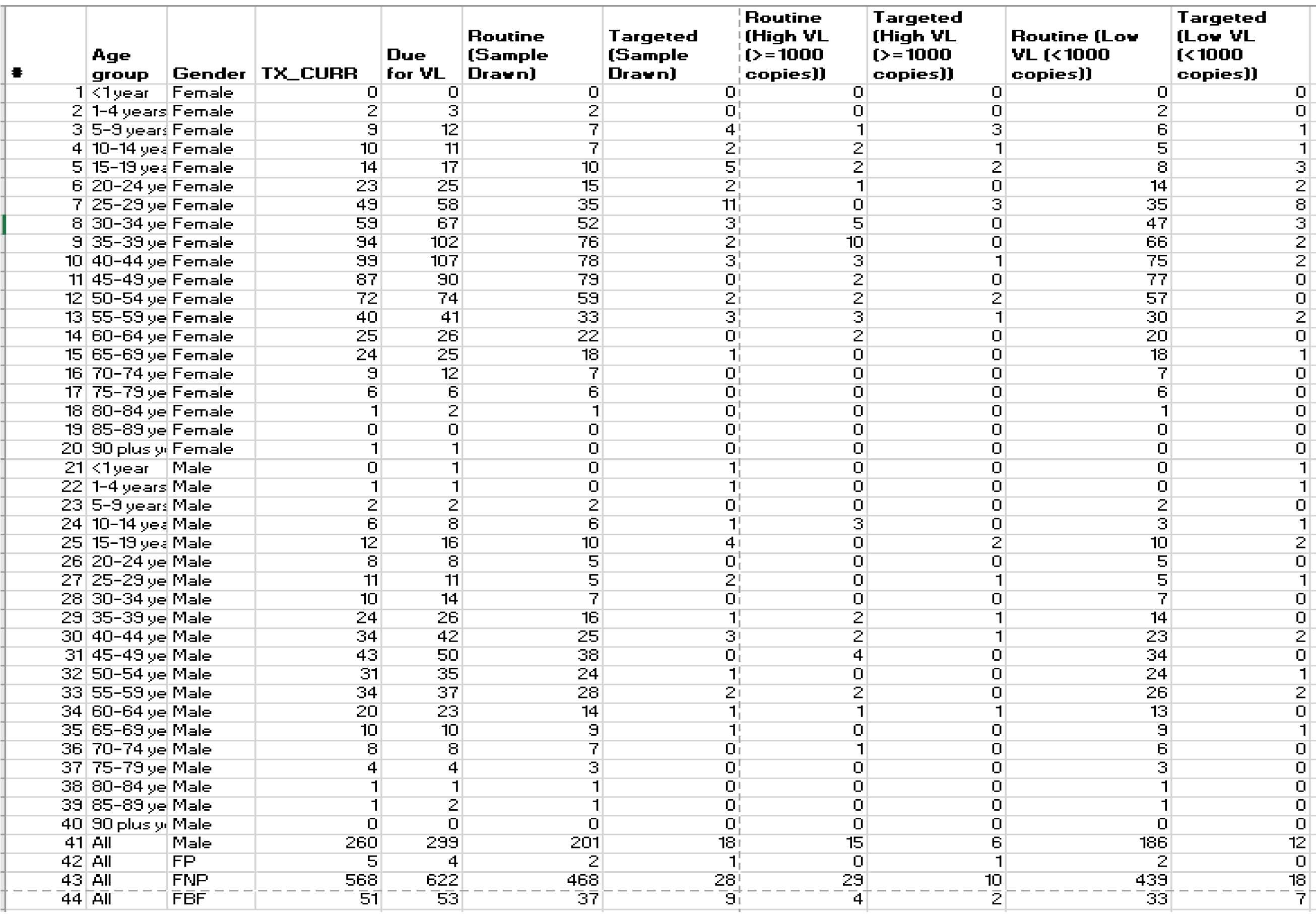
According to PEPFAR MER guidelines, Viral Load (VL) reporting is disaggregated to show how patients on ART are monitored and how well treatment is working. The report and indicators shared follows the standard MER Viral Load indicator structure, where results are broken down by age group, gender, and testing type (routine vs targeted). Below is a clearer explanation of the four main categories and their indicators:
▪ TXCURR: The total number of clients currently receiving antiretroviral therapy (ART) at the facility at the end of the reporting period.
▪ Due for VL: Number of ART clients who were expected to receive a viral load test during the reporting period including clients that includes clients that were alive at the beginning or during reporting period and had an adverse outcome (Died, Defaulted, transferred out & Stopped treatment) by the end of the reporting period. Clients are due for VL after 6 months on ART and annually thereafter.
▪ Sample Drawn:
o Routine VL Sample Drawn: Routine viral load testing is conducted for stable ART clients as part of regular monitoring. The report captures samples taken (testing done) for the past 12 months.
o Targeted VL Sample Drawn: Targeted viral load testing is conducted for clients suspected of treatment failure (initiated by clinical staff). The report captures samples taken (testing done) for the past 12 months.

Table 5: TX_PVLS (VL Coverage) Report
TX_TB
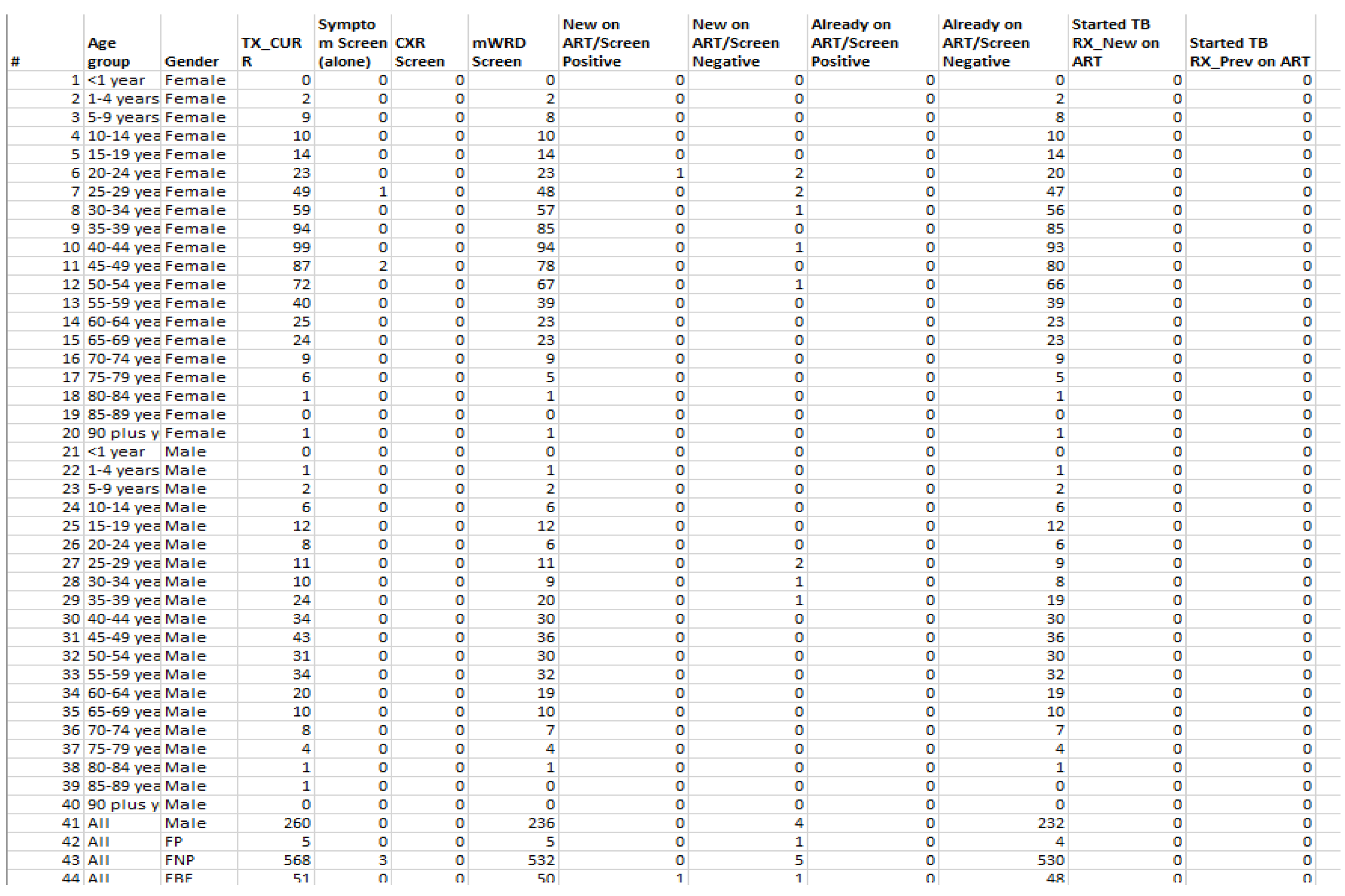
Proportion of ART patients screened for TB in the semi-annual reporting period and those that start TB treatment. This report captures the TB screening of ART patients as well as the proportion who were diagnosed and started on TB therapy. The disaggregates demonstrate the cascade from screening to testing. The report disaggregates the following indicators by Gender and Sex:
▪ TX_CURR: The total number of clients currently receiving antiretroviral therapy (ART) at the facility at the end of the reporting period.
▪ Screening Type: Number of patients that were screened for TB at least once during the reporting period with these types of screening:
o Symptom Screen (alone): Patients who received symptom screening alone (without CXR, or mWRD, or other methods). A screening is considered positive if a patient reports at least one or more W4SS symptom during the reporting period.
o CXR Screen: Patients who received a CXR for screening purposes, with or without symptom screening.
o mWRD Screen: Patients who received an mWRD for screening purposes, with or without symptom screening. A screening is considered positive if Mycobacterium Tuberculosis (MTB) is detected.
When multiple screening methods are used for the same patient, only the result from the most advanced or confirmatory screening method is recorded in the final reporting category. For example, if a patient initially receives a symptom screen and is later screened using Chest X-ray (CXR), the patient will be counted only under the CXR screening category, not under symptom screening. Similarly, if a patient undergoes CXR screening and subsequently receives a mWRD, the patient will be reported only under the mWRD screening category.
▪ New on ART/Screen Positive: The number of patients who initiated antiretroviral therapy (ART) during the reporting period and whose most recent TB screening result during the same reporting period was positive, according to the relevant Type of Screening.
▪ New on ART/Screen Negative: The number of patients who initiated antiretroviral therapy (ART) during the reporting period and whose most recent TB screening result during the same reporting period was negative, according to the relevant Type of Screening.
▪ Already on ART/Screen Positive: The number of patients who were already receiving ART prior to the reporting period and whose most recent TB screening during the reporting period was positive, based on the applicable Type of Screening.
▪ Already on ART/Screen Negative: The number of patients who were already receiving ART prior to the reporting period and whose most recent TB screening result during the reporting period was negative, according to the relevant Type of Screening.
▪ Started TB RX_New on ART: The number of patients who initiated antiretroviral therapy (ART) during the reporting period and were diagnosed with active TB and started on TB treatment during the same reporting period.
▪ Started TB RX_Prev on ART: The number of patients who were already receiving ART prior to the reporting period and were diagnosed with active TB and initiated on TB treatment during the reporting period.
Table 6: TX_TB Report
SC ARV Dispensation
• The number of adult and pediatric ARV bottles (units) dispensed by ARV drug category at the end of the reporting period.
• Semi-Annually Report
• Products included in the “Other” category consist of, first, commodities not listed in the product-specific disaggregates and, second, those which are used for second- and third-line treatment only. These are expected to be a much smaller proportion of the total than DTG-based regimens
Table 8: SC ARV DISP Report
| # | ARV drug category | # of bottles (units) dispensed |
| 1 | TLD 30-count bottles | 308 |
| 2 | TLD 90-count bottles | 654 |
| 3 | TLD 180-count bottles | 411 |
| 4 | TLE/400 30-count bottles | 0 |
| 5 | TLE/400 90-count bottles | 0 |
| 6 | TLE 600/TEE bottles | 0 |
| 7 | DTG 10 90-count bottles | 10 |
| 8 | DTG 50 30-count bottles | 44 |
| 9 | LPV/r 100/25 tabs 60 tabs/bottle | 0 |
| 10 | LPV/r 40/10 (pediatrics) bottles | 0 |
| 11 | NVP (adult) bottles | 0 |
| 12 | NVP (pediatric) bottles | 0 |
| 13 | Other (adult) bottles | 27 |
| 14 | Other (pediatric) bottles | 35 |