Reporting
Reporting requirements are defined by multiple stakeholders. This is why implementation of the reports in the ART module categorizes the reports into three main categories:
- MOH Reports
- Clinic Reports and
- Pepfar reports
We will cover these reports in a bit more detail in this section.
PEPFAR REPORTS
The main difference between PEPFAR reports and MoH reports is the calculation of clients that have defaulted; for PEPFAR a client that has defaulted is calculated as; 30 days after running out of medication.
TX_NEW
Number of Adults and Children Newly Enrolled on Antiretroviral Therapy (ART). This report provides the number of adults and children who were newly enrolled on Antiretroviral Therapy (ART) during the reporting period. It includes patients who started ART for the first time at the facility. The report is disaggregated by age and sex and further categorized based on CD4 count at the time of ART initiation. Reporting indicators include:
▪ Tx new CD4 < 200: Newly initiated clients with CD4 results less than 200
▪ Tx new CD4 >= 200: Newly initiated clients with CD4 results equal to or greater than 200
▪ Tx new CD4 Unknown: Newly initiated clients with CD4 results not done
▪ Transfer-ins: Patients who initiated ART at another facility but were newly enrolled at the reporting facility during the reporting period.
Table 1: TX_NEW report template
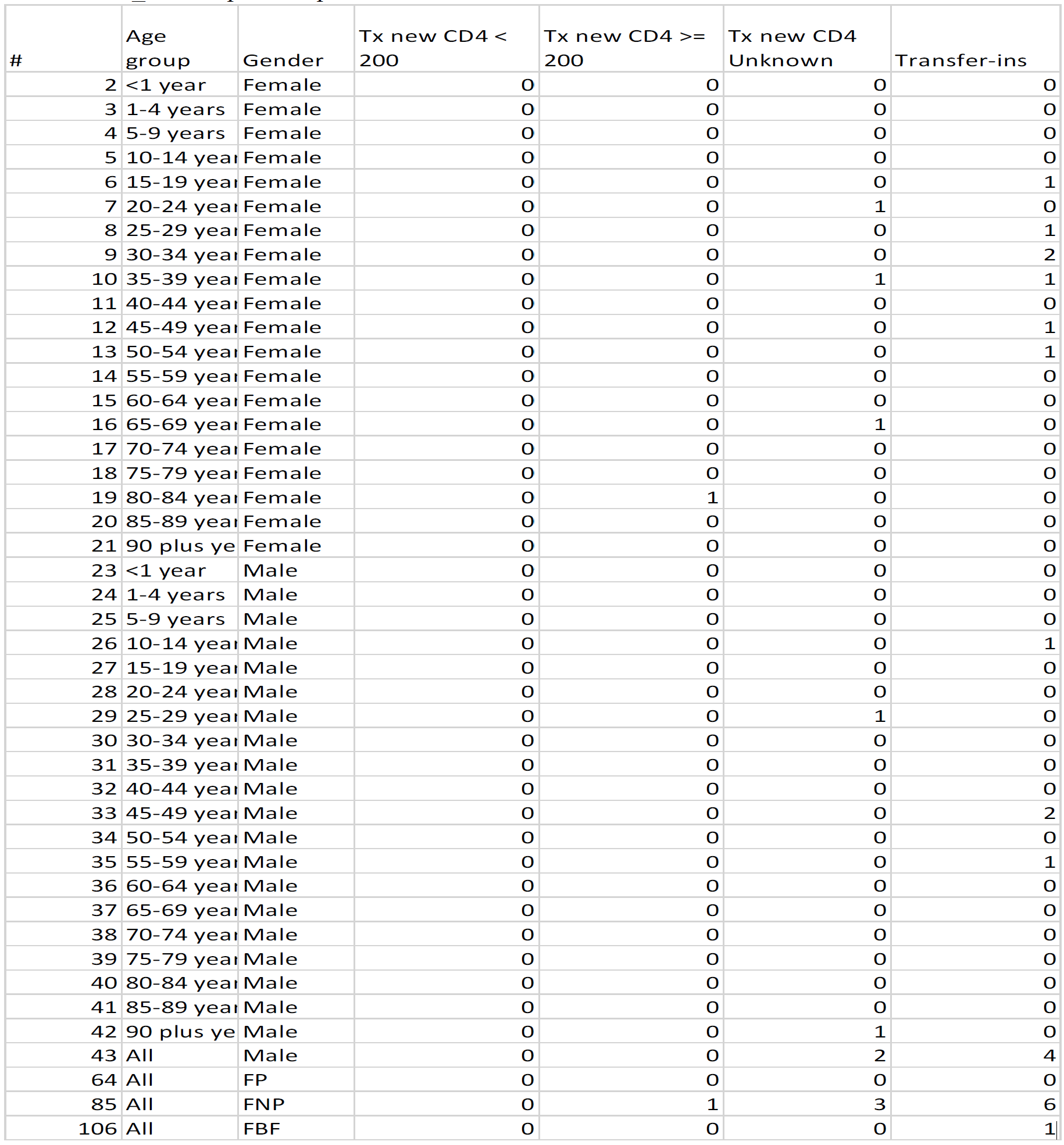
EMR Calculation: The EMR system calculates this indicator as follows: Identify all patients with an ART start date within the reporting period, confirm that the ART initiation is the first recorded ART start for the patient, retrieve the patient’s age at ART start and categorize into the defined CD4 results (if available).
TX_RTT
Number of ART patients who experienced an interruption in treatment (IIT) during any previous reporting period, who successfully restarted ARVs within the reporting period and remained on treatment until the end of the reporting period. TX_RTT counts those individuals who fulfill all of the following:
▪ Initiated ART prior to the start of the reporting period.
▪ Were not on treatment at the beginning of the reporting period after experiencing an interruption in treatment (i.e., more than 30 days since the last expected clinical contact).
▪ Restarted ARVs during the reporting period.
▪ Remained on treatment at the end of the reporting period.
This indicator helps programs track the effectiveness of patient tracing, retention strategies, and re-engagement efforts for individuals who previously interrupted ART.
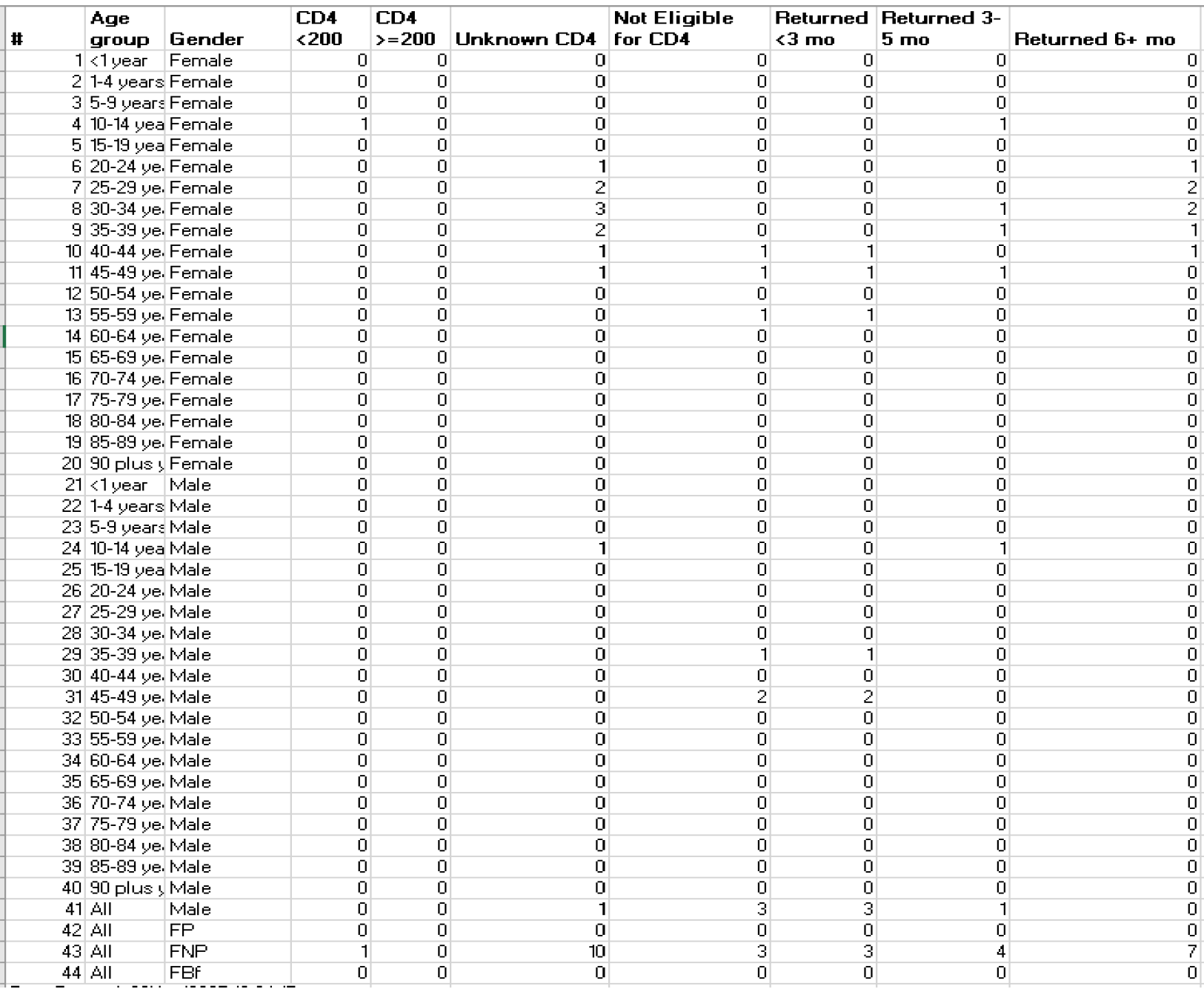
♦UPDATE TO TX_RTT: Added a disaggregate on duration of interruption in treatment and CD4 results at point of restarting ART in the report. The following are the reporting indicators disaggregated by age and sex:
▪ CD4 <200: Number of ART patients who restarted treatment during the reporting period and had a CD4 count result of less than 200.
▪ CD4 >=200: Number of ART patients who restarted treatment during the reporting period and had a CD4 count result of 200 or higher at or near the time of ART restart.
▪ Unknown CD4: Number of ART patients who restarted treatment during the reporting period without a recorded CD4 test result at the time of ART restart.
▪ Not Eligible for CD4: Number of ART patients who restarted treatment during the reporting period but were not eligible for a CD4 test according to national HIV treatment guidelines.
▪ Returned <3 months: Number of ART patients who restarted treatment during the reporting period within less than three months after experiencing an interruption in treatment.
▪ Returned 3-5 months: Number of ART patients who restarted treatment during the reporting period between three and five months after experiencing an interruption in treatment.
▪ Returned 6+ months: Number of ART patients who restarted treatment during the reporting period six months or more after experiencing an interruption in treatment.
Table 2: TX_RTT Report
TX_ML
Number of ART patients (who were on ART at the beginning of the quarterly reporting period or initiated treatment during the reporting period) and then had no clinical contact since their last expected contact.
The outcomes are defined as not currently on ART at the facility if the patient:
• Died
• Interruption in treatment (IIT)
• On treatment for <3 months when experienced IIT
• On treatment for 3-5 months when experienced IIT
• On treatment for 6+ months when experienced IIT
• Transferred out
• Refused (stopped) treatment
Included in the classification of IIT are the following: patients for whom tracing is not attempted, and patients for whom tracing is attempted but unsuccessful or for whom status cannot otherwise be determined (i.e., patient may have died or may have silently transferred, but status is unknown). Patients should also be reported as IIT if they have been traced and scheduled to return after the end of the reporting period (in other words, they have not returned yet). A facility may wish to further distinguish these classifications, but they are not required for MER reporting.
Table 3: TX_ML Report
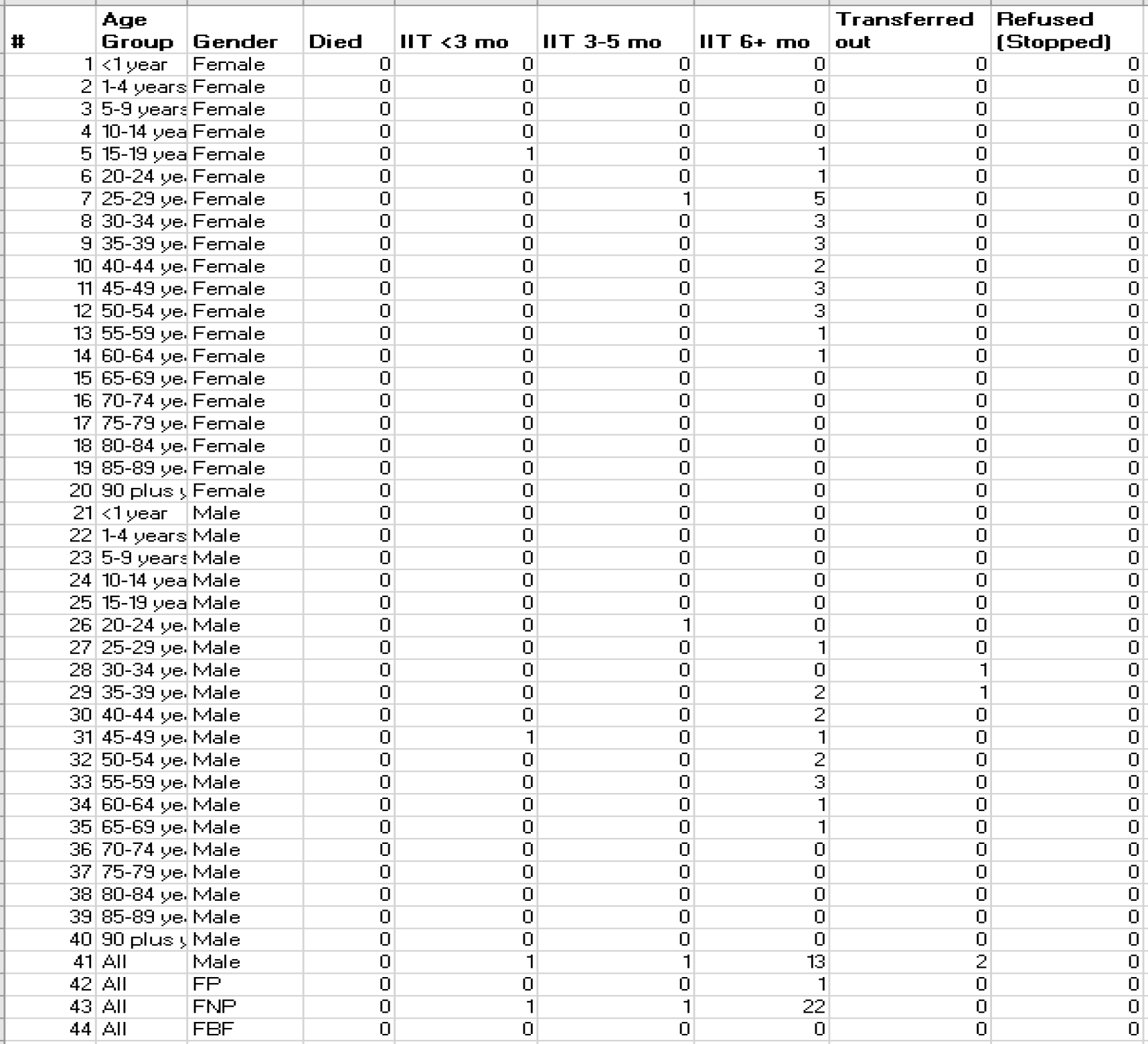
♦EMR calculations: All clients within the HIV program that were on ART at the start of the reporting period and clients that enrolled in the reporting period; are not on treatment by the end of the reporting period.
Step-by-step EMR Calculation description:
a) Select all clients that were registered in the HIV program before the start of the reporting period and they are Alive and on treatment. For example, if the reporting period is 1st January 2020 to 31st March 2020, then the start date is 1st January 2020.
b) From the previous step, the systems will add all new clients enrolled in the reporting period and were Alive and on treatment after being enrolled. For example, if the reporting period is 1st January 2020 to 31st March 2020, then all clients that were enrolled between the stated dates.
c) After selecting all Alive on treatment clients, the EMR will loop through each client checking the client’s outcome status at the end of the reporting period. If the outcome is Alive on treatment, then that client will be removed from the list.
d) The remaining clients (clients that are not in care) left from the loop (previous step), the system will classify them in their appropriate age groups using the cohort age group function (see Figure 1: Cohort disaggregated age group function) and their outcome status as of the end of reporting period.
TB_PREV
Proportion of ART patients who started on a standard course of TB Preventive Treatment (TPT) in the previous reporting period who completed therapy by the end of the reporting period.
Numerator: Among those who started a course of TPT in the previous reporting period, the number that completed a full course of therapy (for continuous IPT programs, this includes the patients who have completed the first 6 months of isoniazid preventive therapy (IPT), or any other standard course of TPT such as 3 months of weekly isoniazid and rifapentine, or 3-HP).
Denominator: Number of patients who were initiated on any course of TPT during the previous reporting period
Disaggregates on the timing of ART and age/sex breakdowns will allow programs to monitor those who are newly starting ART, an important focal population in all countries and in particular in countries that have already provided TPT for many of their PLHIV in care.
This report comprises two sub-reports, the first is on clients who started INH in the 180 days period prior to the reporting period and the second is on clients who started 3HP prior to the reporting period. Besides the expected Age group and Gender disaggregates, the clients are further classified in two main categories; New on ART and Previously on ART.
• New on ART are individuals initiated TPT within 6 months of being enrolled on ART and
• Previously on ART are individuals initiated TPT at least 6 months (or longer) after being enrolled on ART
Table 4: TB_PREV Report
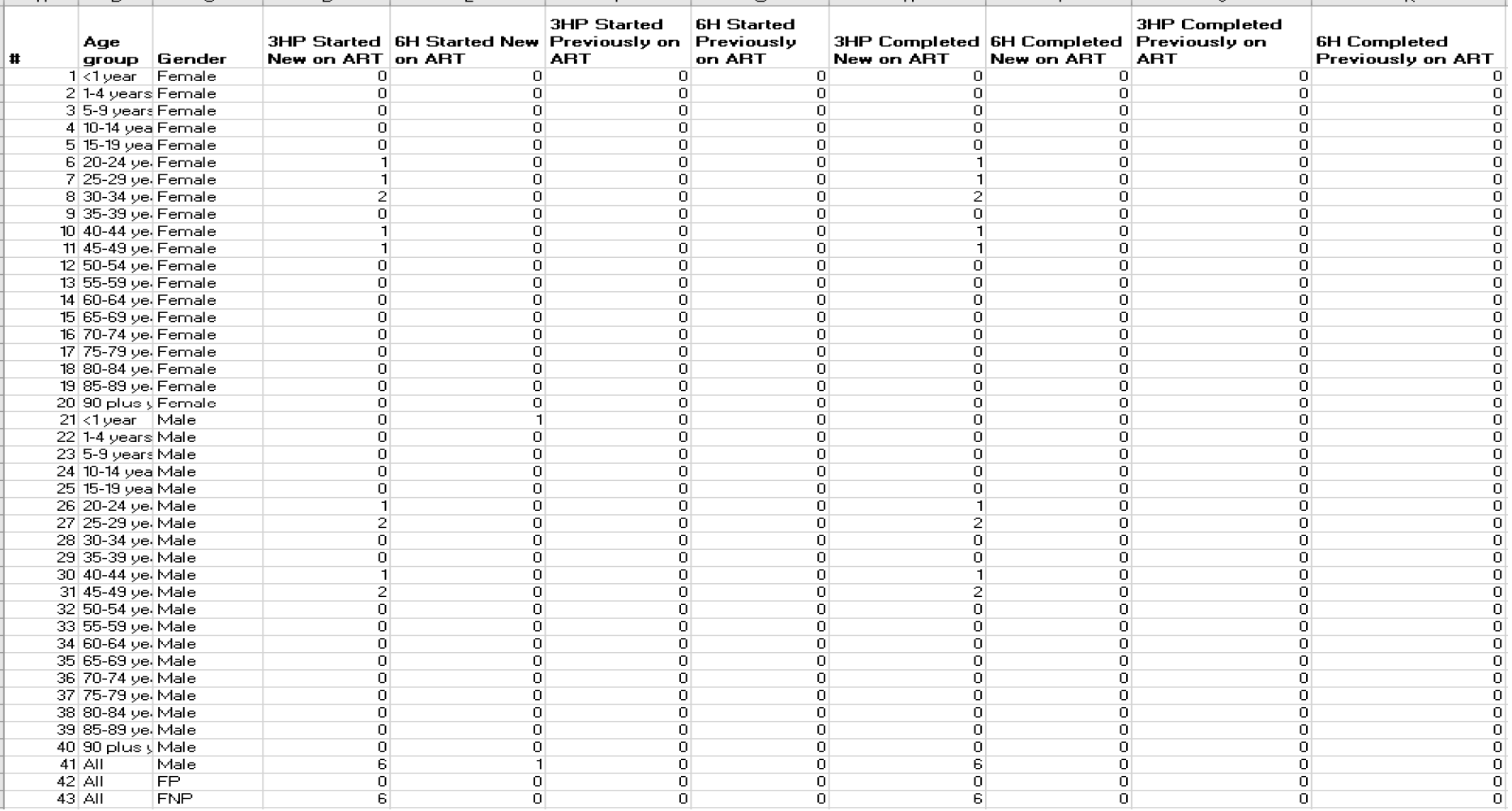
For the system or report to classify a client as completed TPT, the client has to accumulate / consumed a total of 168 or more pills of INH between their first INH dispensations to the end of the reporting period or the client has to complete 3 months’ worth of 3HP (3HP course is not defined by number of pills taken because the dosages for the drug vary by weight, so looking at the prescription period is much safer). For the system or report to classify a client as completed TPT, the client has to accumulate / consumed a total of 168 or more pills of INH between their first INH dispensations to the end of the reporting period. For example, let us say we have 200 clients that has started INH on the 1st October 2019 to 31st March 2020 and had monthly INH follow-up visits on; among these 200 clients, 50 were newly on ART and 150 were previously on ART.
Visit date Drugs Given
1st October 2019 INH 30 pills
1st November 2019 INH 30 pills
1st December 2019 INH 30 pills
1st January 2020 INH 30 pills
1st February 2020 INH 30 pills
1st March 2020 INH 30 pills
If reporting for Q4, 2021 (April to September 2021), the system and the report is focusing on clients that started TPT in the Previous reporting period (October to March). For example, if a client started 6H in November 2020, they will complete TPT in April 2021 (after 6 months) if they do not miss any dosses or clinical visits for 6 months.
If a client starts 3HP in December 2020, they should complete TPT in February 2021 (After 3 months) if they do not miss any dosses or clinical visits for 3 months. The report sums up the accumulated number of prescription days for the drug and checks whether this adds up to 90 days or more.
TX PVLS (VL COVERAGE)
Percentage of ART patients with a suppressed viral load (VL) result (<1000 copies/ml) documented in the medical or laboratory records/laboratory information systems (LIS) within the past 12 months.
Numerator: Number of ART patients with suppressed VL results (<1,000 copies/ml) documented in the medical or laboratory records/LIS within the past 12 months.
Denominator: Number of ART patients with a VL result documented in the medical or laboratory records/LIS within the past 12 months.
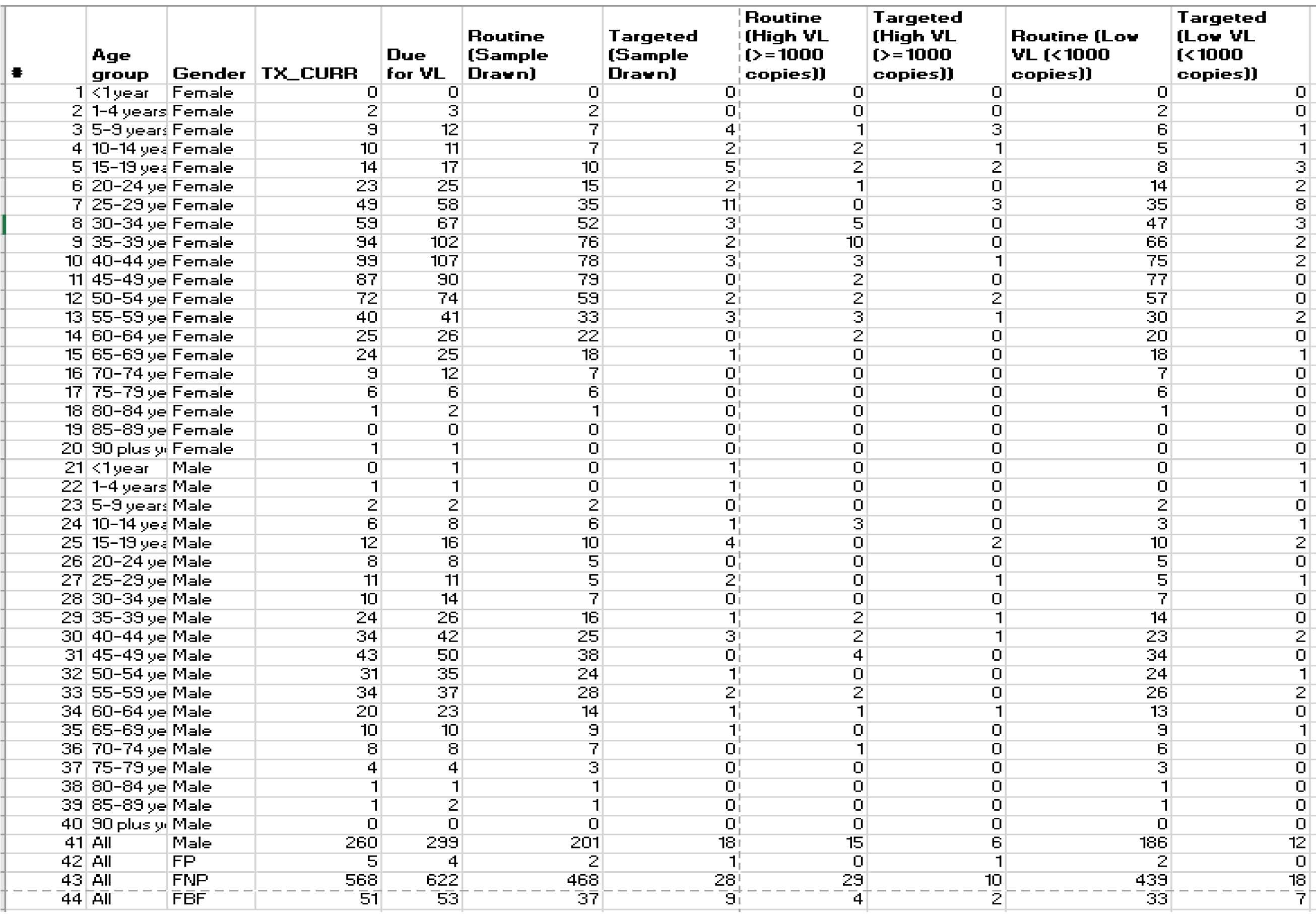
According to PEPFAR MER guidelines, Viral Load (VL) reporting is disaggregated to show how patients on ART are monitored and how well treatment is working. The report and indicators shared follows the standard MER Viral Load indicator structure, where results are broken down by age group, gender, and testing type (routine vs targeted). Below is a clearer explanation of the four main categories and their indicators:
▪ TXCURR: The total number of clients currently receiving antiretroviral therapy (ART) at the facility at the end of the reporting period.
▪ Due for VL: Number of ART clients who were expected to receive a viral load test during the reporting period including clients that includes clients that were alive at the beginning or during reporting period and had an adverse outcome (Died, Defaulted, transferred out & Stopped treatment) by the end of the reporting period. Clients are due for VL after 6 months on ART and annually thereafter.
▪ Sample Drawn:
o Routine VL Sample Drawn: Routine viral load testing is conducted for stable ART clients as part of regular monitoring. The report captures samples taken (testing done) for the past 12 months.
o Targeted VL Sample Drawn: Targeted viral load testing is conducted for clients suspected of treatment failure (initiated by clinical staff). The report captures samples taken (testing done) for the past 12 months.

Table 5: TX_PVLS (VL Coverage) Report
TX_TB
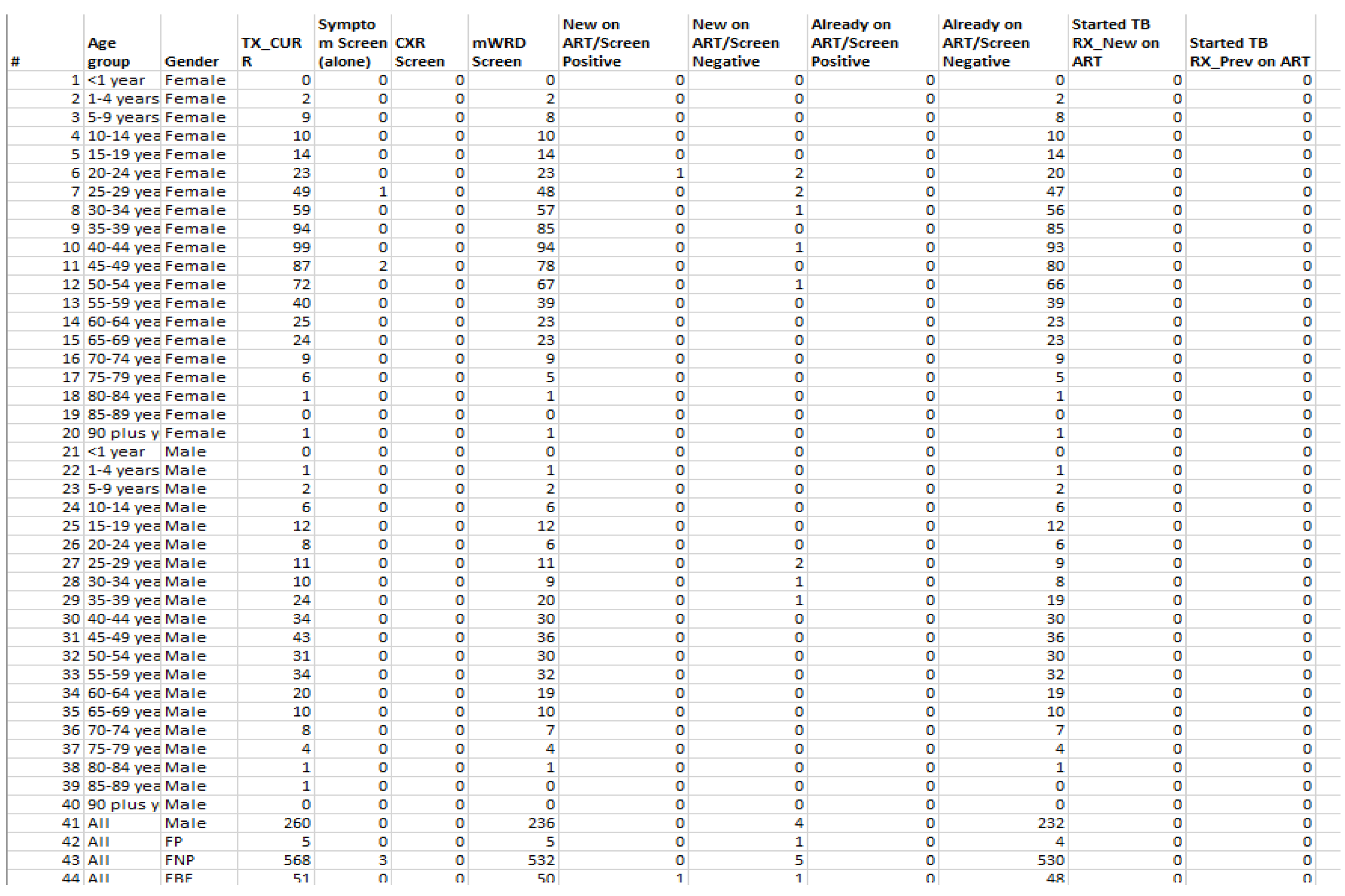
Proportion of ART patients screened for TB in the semi-annual reporting period and those that start TB treatment. This report captures the TB screening of ART patients as well as the proportion who were diagnosed and started on TB therapy. The disaggregates demonstrate the cascade from screening to testing. The report disaggregates the following indicators by Gender and Sex:
▪ TX_CURR: The total number of clients currently receiving antiretroviral therapy (ART) at the facility at the end of the reporting period.
▪ Screening Type: Number of patients that were screened for TB at least once during the reporting period with these types of screening:
o Symptom Screen (alone): Patients who received symptom screening alone (without CXR, or mWRD, or other methods). A screening is considered positive if a patient reports at least one or more W4SS symptom during the reporting period.
o CXR Screen: Patients who received a CXR for screening purposes, with or without symptom screening.
o mWRD Screen: Patients who received an mWRD for screening purposes, with or without symptom screening. A screening is considered positive if Mycobacterium Tuberculosis (MTB) is detected.
When multiple screening methods are used for the same patient, only the result from the most advanced or confirmatory screening method is recorded in the final reporting category. For example, if a patient initially receives a symptom screen and is later screened using Chest X-ray (CXR), the patient will be counted only under the CXR screening category, not under symptom screening. Similarly, if a patient undergoes CXR screening and subsequently receives a mWRD, the patient will be reported only under the mWRD screening category.
▪ New on ART/Screen Positive: The number of patients who initiated antiretroviral therapy (ART) during the reporting period and whose most recent TB screening result during the same reporting period was positive, according to the relevant Type of Screening.
▪ New on ART/Screen Negative: The number of patients who initiated antiretroviral therapy (ART) during the reporting period and whose most recent TB screening result during the same reporting period was negative, according to the relevant Type of Screening.
▪ Already on ART/Screen Positive: The number of patients who were already receiving ART prior to the reporting period and whose most recent TB screening during the reporting period was positive, based on the applicable Type of Screening.
▪ Already on ART/Screen Negative: The number of patients who were already receiving ART prior to the reporting period and whose most recent TB screening result during the reporting period was negative, according to the relevant Type of Screening.
▪ Started TB RX_New on ART: The number of patients who initiated antiretroviral therapy (ART) during the reporting period and were diagnosed with active TB and started on TB treatment during the same reporting period.
▪ Started TB RX_Prev on ART: The number of patients who were already receiving ART prior to the reporting period and were diagnosed with active TB and initiated on TB treatment during the reporting period.
Table 6: TX_TB Report
SC ARV Dispensation
• The number of adult and pediatric ARV bottles (units) dispensed by ARV drug category at the end of the reporting period.
• Semi-Annually Report
• Products included in the “Other” category consist of, first, commodities not listed in the product-specific disaggregates and, second, those which are used for second- and third-line treatment only. These are expected to be a much smaller proportion of the total than DTG-based regimens
Table 8: SC ARV DISP Report
| # | ARV drug category | # of bottles (units) dispensed |
| 1 | TLD 30-count bottles | 308 |
| 2 | TLD 90-count bottles | 654 |
| 3 | TLD 180-count bottles | 411 |
| 4 | TLE/400 30-count bottles | 0 |
| 5 | TLE/400 90-count bottles | 0 |
| 6 | TLE 600/TEE bottles | 0 |
| 7 | DTG 10 90-count bottles | 10 |
| 8 | DTG 50 30-count bottles | 44 |
| 9 | LPV/r 100/25 tabs 60 tabs/bottle | 0 |
| 10 | LPV/r 40/10 (pediatrics) bottles | 0 |
| 11 | NVP (adult) bottles | 0 |
| 12 | NVP (pediatric) bottles | 0 |
| 13 | Other (adult) bottles | 27 |
| 14 | Other (pediatric) bottles | 35 |
MOH REPORTS
1. MOH Cohort Report
A quarterly aggregate summary of all patients enrolled in the HIV program at the facility, showing their cumulative treatment outcomes as of the end of the reporting quarter.
The Cohort Report operates on two populations simultaneously:
|
Population |
Definition |
|
Quarterly |
Patients enrolled for the first time during the current reporting quarter |
|
Cumulative |
All patients ever enrolled since the facility's first ART patient |
Key Indicators and Their Derivation
|
Cohort Report Indicator |
Code |
How it is calculated |
|
Total Registered (Cumulative) |
cum_total_registered |
COUNT of all patients in temp_earliest_start_date (deduplicated earliest enrolment per patient) enrolled before the end date |
|
Total Registered (Quarterly) |
quarterly_total_registered |
COUNT of patients with date_enrolled falling within the current quarter start-to-end date |
|
Initiated on ART First Time (FT) |
initiated_on_art_first_time |
Patients whose earliest ARV order date equals their ART registration date, excluding transfers-in |
|
Transfers In (TI) |
transfer_in |
Patients with a Transfer-In program state before the end date |
|
Total Alive and On ART |
total_alive_and_on_art |
COUNT of patients where moh_cum_outcome = 'On antiretrovirals' at end of reporting period |
|
Defaulted |
defaulted |
Patients where MoH supply expiry + 60 days < report end date (i.e., overdue for >2 months) |
|
Died Total |
died_total |
Patients with Patient died state at any time up to end date |
|
Died within 1st month of ART (M1) |
died_within_the_1st_month_of_art_initiation |
Patients who died AND death date - ART start date ≤ 30 days |
|
Died within 2nd month (M2) |
died_within_the_2nd_month_of_art_initiation |
Death date 31–60 days after ART start |
|
Died within 3rd month (M3) |
died_within_the_3rd_month_of_art_initiation |
Death date 61–90 days after ART start |
|
Died after 3rd month (M4+) |
died_after_the_3rd_month_of_art_initiation |
Death date > 90 days after ART start |
|
Transferred Out (TO) |
transfered_out |
Patients with Transferred out terminal program state before end date |
|
Treatment Stopped |
stopped_art |
Patients with Treatment stopped terminal program state before end date |
|
Unknown outcome |
unknown_outcome |
Patients with outcome = 'Unknown' (enrolled but no ARV orders on record) |
Reason for Starting ART Disaggregations
The Cohort Report also records the clinical reason for initiating ART. These are extracted from the HIV Clinic Registration encounter observation (concept: "Reason for ART eligibility"):
|
Cohort Field |
Clinical Meaning |
|
no_tb |
Never had TB or TB was > 2 years ago |
|
tb_within_the_last_two_years |
History of TB within the past 2 years |
|
current_episode_of_tb |
Currently on TB treatment at ART initiation |
|
who_stage_two |
CD4 count below threshold (CD4-based eligibility) |
|
who_stage_three |
WHO clinical stage 3 |
|
who_stage_four |
WHO clinical stage 4 |
|
asymptomatic |
Asymptomatic or mild (WHO stage 1/2, treat-all era) |
|
pregnant_women |
Pregnant (Option B+) |
|
presumed_severe_hiv_disease_in_infants |
Presumed severe HIV disease in infants < 12 months |
|
confirmed_hiv_infection_in_infants_pcr |
PCR-confirmed HIV in infants < 12 months |
Age/Sex Sub-categories
|
Field |
Definition |
|
all_males |
All male patients regardless of age |
|
non_pregnant_females |
All female patients not recorded as pregnant |
|
pregnant_females_all_ages |
Female patients with "pregnant" at ART initiation |
|
breastfeeding_mothers |
Female patients with "breastfeeding" at ART initiation |
|
children_below_24_months_at_art_initiation |
Age at ART start < 24 months |
|
children_24_months_14_years_at_art_initiation |
Age at ART start 24 months–14 years |
|
adults_at_art_initiation |
Age at ART start ≥ 15 years |
|
children_12_59_months |
Age at report end date 12–59 months |
Adherence Indicators
|
Field |
Source |
|
patients_with_0_6_doses_missed |
Last visit before end of quarter — pill count recorded as 0–6 doses missed |
|
patients_with_7_plus_doses_missed |
Last visit before end of quarter — pill count recorded as ≥ 7 doses missed |
Pill count observations are retrieved from encounters (concept: "Pill count") dated on or before the end of the quarter.
Side Effects, TB Status, CPT/IPT
These are extracted from the most recent clinical encounter (ART visit) before the end of the reporting quarter:
-
TB status: From the "TB status" observation on the last visit
-
Side effects: From the "Drug-induced" observation on the last visit
-
CPT/IPT/3HP: Derived from active drug orders for Cotrimoxazole, Isoniazid, or Rifapentine/Isoniazid combination on or before the end date
Reporting period: Quarterly. Cumulative figures include all history; quarterly figures use the quarter start and end dates for the date_enrolled filter.
2. Disaggregated Report (TX_CURR by Age/Sex/Regimen)
PEPFAR MER Equivalent: TX_CURR (disaggregated)
The number of patients currently alive and receiving ART, disaggregated by age group, sex, and ART regimen as of the end of the reporting period.
Numerator: Patients in temp_patient_outcomes where:
-
moh_cum_outcome = 'On antiretrovirals' (MoH definition) OR
-
pepfar_cum_outcome = 'On antiretrovirals' (PEPFAR definition)
-
AND Sex is 'M' or 'F' (patients with missing or unknown Sex are excluded from the main disaggregation)
Data Source
temp_current_medication table (populated from the most recently dispensed ARV drug orders per patient) joined to temp_patient_outcomes. Regimen is determined by matching the set of dispensed drug IDs (from moh_regimen_combination_drug and moh_regimen_combination) to the MoH-approved regimen combination table.
Regimen Classification Logic:
-
The system retrieves each patient's active ARV drug IDs from their latest dispense date.
-
These are concatenated in drug_id ascending order and matched against the moh_regimen_combination lookup table.
-
If no match exists, the patient is classified as "Unknown" (non-standard regimen or data gap).
-
Regimen codes follow MoH Malawi format: 0P, 0A, 2A, 4PP, 4PA, 4A, 5A, 6A, 7A, 8A, 9PP, 9PA, 9A, 10A, 11PP, 11PA, 11A, 12PP, 12PA, 12A, 13A, 14PP, 14PA, 14A, 15P, 15PP, 15PA, 15A, 16P, 16A, 17PA, 17PP, 17A.
Age Group Disaggregation:
The disaggregated_age_group() database function calculates age in years at the report end date using birthdate. Standard PEPFAR age bands are applied: <1 year, 1–4, 5–9, 10–14, 15–19, 20–24, 25–29, 30–34, 35–39, 40–44, 45–49, 50–54, 55–59, 60–64, 65–69, 70–74, 75–79, 80–84, 85–89, 90+ years.
Sex Disaggregation:
-
M (Male)
-
F (Female — further split into FP pregnant, FNP non-pregnant, FBf breastfeeding in aggregate "All" row)
Maternal Status (FP/FBf):
Applied only to the aggregate "All" row. Pregnancy/breastfeeding status is determined by the ViralLoadCoverage2.vl_maternal_status() service, which checks:
-
Active pregnancy observation on or near the VL due date
-
Active breastfeeding observation recorded in the ART visit encounter near the end date
Denominator: Not applicable (count, not a proportion).
Reporting period: Quarterly. Age is calculated at the end date of the reporting period.
DQ Note:
Patients with no Sex recorded in the system are excluded from all age/sex disaggregations but are included in the total TX_CURR figure. Mismatches between the MoH and PEPFAR disaggregated totals arise from the different defaulter thresholds (60 days MoH vs 28 days PEPFAR).
3. TX Curr MMD Report (Multi-Month Dispensing)
PEPFAR MER Equivalent: TX_CURR_MMD (MMD sub-indicator)
Among all patients currently alive and on ART (TX_CURR), how many received ≥ 3 months, ≥ 6 months, or < 3 months of ARV supply at their most recent dispense within the reporting period?
Data Source
Each patient's most recent ARV dispensing encounter before the end date (using moh_regimen_combination and drug order records). The number of prescribed days is derived from:
Prescribed Days = (Quantity Dispensed + Pill Count Carryover) ÷ Daily Dose
where daily dose is sourced per-drug from the moh_regimen_doses table based on the patient's current weight. If the weight-based calculation fails, the system uses the auto_expire_date recorded on the order.
|
Indicator |
Definition |
|
< 3 months of ARVs |
Prescribed days < 84 days at last dispense |
|
3–5 months of ARVs |
Prescribed days ≥ 84 and < 168 days |
|
≥ 6 months of ARVs |
Prescribed days ≥ 168 days |
Population: Only patients classified as 'On antiretrovirals' per the applicable outcome definition (MoH or PEPFAR). Age/sex filter can be applied (standard PEPFAR age bands).
Disaggregations: Age group × sex (same bands as TX_CURR disaggregated).
Validation: The HIS-Core frontend validates TX Curr MMD totals against the MoH Cohort Report TX_CURR figure. A warning is raised if numbers diverge, indicating rebuilding the cohort is needed.
Reporting period: Quarterly.
4. TX TB Report (TB Screening among ART Patients)
PEPFAR MER Equivalent: TX_TB
Among patients currently alive and on ART (TX_CURR), the proportion of those who were screened for TB during the reporting period. Separate counts are maintained for newly initiated ART patients and those already established on ART.
|
Indicator |
Derivation |
|
TX_CURR |
All patients alive and on ART — baseline denominator |
|
Symptom Screen (alone) |
Patients with a TB symptom screen observation (no CXR or mWRD ordered) recorded in their ART visit encounter during the period |
|
CXR Screen |
Patients with a Chest X-ray (CXR) test ordered or resulted during the period |
|
mWRD Screen |
Patients with a molecular WHO-recommended rapid diagnostic (Xpert MTB/RIF, LAMP, or equivalent) test ordered during the period |
|
New on ART / Screen Positive |
Patients in their first quarter on ART with a positive screen result |
|
New on ART / Screen Negative |
Patients in their first quarter on ART with a negative screen result |
|
Already on ART / Screen Positive |
Established ART patients (> 1 quarter) with a positive screen |
|
Already on ART / Screen Negative |
Established ART patients with a negative screen |
|
TB RX — New on ART |
New ART patients who were started on TB treatment during the period |
|
TB RX — Prev on ART |
Established ART patients started on TB treatment during the period |
Data Source
TB status observations from ART visit encounters (encounter type: ART Visit). Observations linked to concept "TB status" or "TB treatment" within the reporting period. TB treatment initiation is detected from drug orders for TB drugs (Rifampicin-based regimens).
"New on ART" is defined as: ART start date falls within the reporting quarter (i.e., date enrolled ≥ quarter start date AND ≤ quarter end date).
Disaggregations: Age group × sex (standard PEPFAR bands).
Reporting period: Quarterly.
5. MoH Regimen Report
A patient-level listing of all ARV drugs dispensed to HIV program patients during the selected date range.
Data Source
Drug order records (orders, drug_order, drug tables) for drugs classified under the "ARV" drug concept set, where quantity > 0 and the dispense date falls within the selected period.
Fields per row:
-
Patient ARV Number (from patient_identifier table, identifier type = ARV Number)
-
Gender and date of birth
-
Drug name (from drug table)
-
Dispense date (orders.start_date)
-
Pack size (from drug.units)
-
Number of packs, total pills (from drug_order.quantity)
Population: All patients with an ARV dispense record in the period, not restricted to currently active patients. Transferred-out or stopped patients who received ARVs in the period will appear.
Reporting period: User-defined date range (typically monthly or quarterly).
DQ Note: This report can be used for pharmacy stock reconciliation cross-checks.
6. MoH Regimen Distribution by Weight
Among all patients currently alive and on ART, the distribution of ART regimens stratified by patient weight band and sex.
Weight Bands: Derived from moh_regimen_doses.min_weight and max_weight brackets. Typical bands: 3–5 kg, 6–9 kg, 10–13 kg, 14–19 kg, 20–24 kg, 25–29 kg, 30–34 kg, 35+ kg.
Regimen Classification: Same logic as Disaggregated Report — matched from moh_regimen_combination.
Data Source
Most recent weight observation (concept: "Weight (Kg)") before the end date, combined with the most recent ARV dispense to determine regimen.
Population: TX_CURR patients only.
Disaggregations: Weight band × sex.
Use case: Primarily for paediatric dosing audit, ensuring children are on a weight-appropriate regimen.
7. Survival Analysis Report
Longitudinal tracking of treatment outcomes for historical patient cohorts (grouped by quarter of ART initiation), observed at the current report end date. Reports the number of patients from each starting cohort who are alive and on ART, died, defaulted, transferred out, or have unknown/stopped outcomes as of the observation date.
Cohort Construction:
-
The system identifies the quarter of ART initiation for each patient from temp_earliest_start_date.date_enrolled.
-
For each historical quarter (going back as far as the facility's earliest HIV encounter), patients enrolled in that quarter are grouped, and their current outcome (as of the report end date) is displayed.
-
The observation interval is expressed as: TIMESTAMPDIFF(months, cohort_end_date, report_end_date) i.e., how many months of follow-up have elapsed since that cohort's quarter ended.
Supported Sub-populations:
|
Sub-group |
Inclusion Criteria |
|
General |
All patients enrolled in that quarter, regardless of sex or reason |
|
Children |
As above, filtered to patients aged < 15 years at the report end date |
|
Option B+ Women (Women) |
Female patients aged ≥ 15 years who were pregnant or breastfeeding at ART initiation, determined by: (a) "Reason for starting ART" observation matching 'pregnant' or 'breast', OR (b) pregnancy/breastfeeding observation recorded on the same day as ART initiation |
Outcomes reported per cohort/interval cell: On antiretrovirals · Patient died · Defaulted · Transferred out · Treatment stopped · Unknown.
Data Source
temp_earliest_start_date (enrolment dates) joined to temp_patient_outcomes (current outcome at the report end date). Outcomes are computed as per the standard outcome resolution algorithm described in Section 1.
Reporting period: Observation date is the report end date. Cohort quarters extend to the full history of the facility (dynamically calculated from the earliest HIV encounter recorded in the system, up to a default maximum of 10 years if no earlier data exists).
DQ Note: Patients transferred in who were given an earlier ART start date at the original facility will appear in historical cohorts for periods before the patient arrived at this facility. Their outcomes are counted from the registered ART start date.
8. MoH TPT Cohort Report
PEPFAR MER Equivalent: TB_PREV (Denominator and Numerator)
Among HIV-positive patients newly initiated on ART during a defined historical quarter (9 months prior to the current reporting period), how many:
-
Were started on TB Preventive Therapy (TPT)
-
Completed TPT (either 3HP or 6H)
-
Did not complete TPT (and the reason, where recorded)
Cohort Calendar Logic
The TPT Cohort report operates on a shifted time window:
Cohort enrolment window = (Report start date − 9 months) to (Report start date − 9 months + 3 months)
i.e., the quarter that ended approximately 6–9 months before the current reporting period
This allows sufficient follow-up time to observe TPT completion (3HP = ~3 months; 6H = 6 months).
TPT Classification Logic
Patients are classified by the drugs ordered during the TPT initiation window:
|
Drugs ordered |
TPT Type assigned |
|
Rifapentine alone or Rifapentine + Isoniazid together |
3HP (3-month Rifapentine/Isoniazid) |
|
Isoniazid alone (concept = Isoniazid) |
6H (6-month Isoniazid Preventive Therapy) |
The system uses concept IDs for: Rifapentine (concept_id = 10565), Isoniazid, and Isoniazid/Rifapentine combination. TPT transfer-in is also considered (from "TPT Drugs Received" observation), where the value_datetime is used as the TPT start date.
Indicators and Their Derivation
|
Indicator |
Derivation |
|
Initiated ART |
COUNT of patients with first ARV order in the cohort enrolment window (patients with any prior ARV order before the window start are excluded, this ensures "newly initiated" only) |
|
Started TPT |
COUNT of patients from the initiated cohort who also have a TPT drug order in the enrolment window |
|
Completed TPT |
Patients who completed the full course: |
|
Not Completed |
Started TPT but did not meet completion criteria by the report end date |
|
Died |
TPT patients whose outcome = 'Patient died' |
|
Defaulted |
TPT patients whose ART outcome = 'Defaulted' (MoH definition) |
|
Stopped ART |
TPT patients with 'Treatment stopped' state |
|
Transfer Out |
TPT patients with 'Transferred out' state |
|
Confirmed TB |
TPT patients with TB treatment initiated after starting TPT (i.e., developed active TB) |
|
Pregnant |
Female TPT patients with a pregnancy observation recorded during the follow-up period |
Data Sources
orders, drug_order (for TPT and ART drug orders), patient_state (for outcomes), obs (for pregnancy/breastfeeding), patient_program (for HIV program enrolment).
Disaggregations: Age group × sex, as standard.
DQ Note:
The "Completed TPT" classification is based on recorded dispenses. If a patient collected TPT from another facility and no transfer-in observation was captured, they will be incorrectly classified as "Not Completed." Data completeness of inter-facility TPT transfer documentation directly affects this indicator.
9. TPT New Initiations Report
PEPFAR MER Equivalent: TX_TB (TB_PREV for the initiation component)
The number of patients newly initiated on TPT during the current reporting quarter, stratified by whether they are new to ART in the same period or were already established on ART, and by TPT regimen type (3HP or 6H).
"New on ART": ART start date falls within the current reporting quarter (first-ever ARV order ≥ quarter start and ≤ quarter end).
"Previously on ART" (Prev): First ARV order was before the current quarter start.
Data Source
TPT drug orders (Rifapentine, Isoniazid concepts) with order dates within the reporting quarter. ART start date from temp_earliest_start_date for classification as new vs. prev.
Disaggregations: District · Age group · Sex · TPT type (3HP / 6H).
Validation: HIS-Core frontend validates total TPT initiations against the MoH Cohort Report. Mismatches are flagged and rebuilding the cohort report is recommended.
CLINIC REPORTS
1. Clinic Defaulters Report
A patient-level list of patients who have missed their expected return date by more than 28 days (PEPFAR IIT threshold) as of the report end date, and who have not yet been recorded as transferred out, died, or having stopped treatment.
Patient Identification Logic:
-
Patient status is "On antiretrovirals" at some point before the report end date
-
Calculated supply expiry date (quantity ÷ daily dose) + 28 days < report end date
-
No active terminal program state (not transferred out, not died, not stopped)
Fields: ARV Number · First name · Last name · Gender · Date of birth · Appointment date · Date defaulted · Phone number · Village · District · TA · Landmark
Data Source
orders, drug_order (for supply dates), patient_identifier (for ARV number), person (for demographics), person_attribute (for phone number), person_address (for location).
Reporting period: User-defined (typically weekly or monthly).
DQ Note:
Accuracy of this report is directly dependent on the quality of dispensing data (quantity and daily dose recorded at each visit). If quantity is not recorded, patients cannot have a supply expiry date calculated and will not appear in this report.
2. Clinic TX RTT Report (Return to Treatment)
PEPFAR MER Equivalent: TX_RTT
The number of ART patients who experienced an Interruption in Treatment (had no clinical contact or ART pick-up for > 28 days after their last expected supply date) but restarted ARVs within the current reporting quarter.
Patient Identification Logic:
A patient is counted as TX_RTT if ALL of the following are true:
-
Previously on ART: Has a program state = 7 (On ART) with a start_date before the quarter start.
-
Not active at start of quarter: Their outcome at quarter start - 1 day was either:
-
Defaulted (supply expired + 28 days before quarter start), OR
-
Treatment stopped (state = 6 in patient_state)
-
Received ART in the quarter: At least one ARV drug order with quantity > 0 was dispensed between quarter start and end.
-
On ART at end of quarter: Outcome at the end date = 'On antiretrovirals' OR the patient had an ARV order with auto_expire_date ≥ (end_date − 60 days).
-
Not on ART in the 60 days before the quarter: No ARV order had its start_date or auto_expire_date in the window from (quarter start − 60 days) to quarter start.
Months-away Classification:
The system computes the duration of IIT as:
Months away = TIMESTAMPDIFF(months, initial_outcome_date, first_ARV_dispense_in_quarter)
Categories:
|
Category |
Months away (PEPFAR IIT duration) |
|
IIT < 3 months |
Returned after < 3 months of interruption |
|
IIT 3–5 months |
Returned after 3–5 months |
|
IIT ≥ 6 months |
Returned after ≥ 6 months |
Disaggregations: Age group × sex.
DQ Note:
The 60-day exclusion window (before the quarter) is used as a practical filter to separate patients who simply had their last dispense close to the quarter boundary, from true IIT returnees. This is a local implementation approximation; the strict PEPFAR MER definition uses 28 days. M&E teams should note this when comparing system TX_RTT figures with manually verified counts.
3. Clinic Retention Report
Among patients initiated on ART during a historical period, how many are still alive and on treatment at 1 month, 3 months, and 6 months after initiation?
Cohort Window: The report selects patients initiated exactly 1, 3, or 6 months before the end of the current reporting period.
Denominator (Initiated): COUNT of patients with date_enrolled in the applicable historical window.
Numerator (Retained): Among those patients, COUNT who currently have moh_cum_outcome = 'On antiretrovirals' at the report end date.
Disaggregations: Age group × sex.
DQ Note:
Patients who transferred out but were retained in care at another facility will appear as "not retained" in this report, causing apparent retention losses that are not true program failures. Transfers-out should be monitored separately.
4. Clinic Regimen Report
A patient-level listing of patients currently on ART with their current regimen, dispensed ARV drugs, weight, and most recent viral load result.
Population: TX_CURR patients (alive and on ART at report end date, MoH definition).
Data Source
-
Regimen: patient_current_regimen() database function at the end date
-
ARV dispense: Most recent drug order records
-
Weight: Most recent "Weight (Kg)" observation
-
Viral load: Most recent viral load observation result (result modifier + numeric value)
-
ART start date: temp_earliest_start_date.earliest_start_date
Reporting period: As of report end date.
5. Clinic Viral Load Report (Patient-level)
A patient-level listing of viral load test results returned during the reporting period, with ability to filter by result type.
Result Classification:
|
Category |
Threshold |
|
Suppressed |
VL result < 1,000 copies/mL (including LDL — lower than detectable limit) |
|
Low-level viraemia |
VL result > 0 and < 1,000 copies/mL (some configurations may separate LDL from this) |
|
High viraemia (Viraemia ≥ 1000) |
VL result ≥ 1,000 copies/mL |
Data Source
Lab results observation (LIMS integration or manual entry) from the obs table where concept = "Viral load" and obs_datetime falls within the reporting period. Linked to the patient's ART program enrolment and most recent regimen.
Fields: ARV Number · Gender · DOB · Specimen type · Order date · VL result (modifier + value) · Result release date · Current regimen.
6. Clinic VL Suppression Report
PEPFAR MER Equivalent: TX_PVLS (Denominator and Numerator, by regimen)
Among patients currently alive and on ART who were due for a viral load within the reporting period, how many had a sample collected (drawn), and of those, how many were virologically suppressed (VL < 1,000 copies/mL)?
Three-level indicator:
Due for VL → Sample Drawn → Result: High VL (≥1000) or Low VL (<1000)
"Due for VL" logic (VL milestone schedule):
The system applies the national VL monitoring schedule via the VlReminder service:
|
Milestone |
Trigger |
|
6-month VL |
6 months after ART start date — for patients newly initiated |
|
12-month VL |
12 months after ART start, where 6-month result exists |
|
Annual VL |
Every 12 months after the last VL result, for established patients |
|
Targeted (High VL follow-up) |
3 months after a high VL result (≥ 1,000 copies/mL) |
Suppression threshold: VL < 1,000 copies/mL OR result coded as "LDL" (lower than detectable limit) = suppressed.
Disaggregation: By ART regimen (same regimen classification as TX_CURR disaggregated). Patients with no matched regimen are classified as "N/A".
Data Source:
-
"Due for VL" list: PatientsAliveAndOnTreatment × VlReminder.vl_reminder_info
-
"Sample Drawn" list: Lab order records with specimen collection date within the period
-
VL result: Most recent LIMS-linked or manually entered VL observation
DQ Note:
The "Due" population is calculated at the patient level using the VL schedule. Patients without a previous VL result or with no ART start date recorded cannot have their VL milestone calculated and will be excluded from the Due count. Ensure ART start dates are accurately recorded for all patients.
7. Clients Due for Viral Load Report
A patient-level list of patients who: (1) have an appointment scheduled within the selected week/period, AND (2) are flagged as due for a viral load test by the VL milestone schedule.
Patient Identification:
-
Alive and on ART (moh_cum_outcome = 'On antiretrovirals')
-
Has an appointment observation (Appointment date concept) with date within the selected period
-
VlReminder.vl_reminder_info.eligible == true- evaluated at the report end date
Fields: Filing/ARV number, Name, Gender, Age, Appointment date, ART start date, Months on ART, VL milestone type, Last VL ordered, Last VL result.
Reporting period: User-defined period (typically weekly).
8. Clinic Lab Results Report
Lab test results returned for HIV program patients during the selected period, viewable in two modes:
|
Mode |
Description |
|
Disaggregated |
Summary counts by age group and sex for each test type |
|
Patient-level |
Individual rows per patient per test |
Data Source
obs table records where the observation concept corresponds to a tracked lab test (CD4 count, viral load, creatinine, ALT, haemoglobin, etc.) and obs_datetime falls within the period. Linked to the HIV program via encounter.program_id = 1.
Available test types are dynamically determined from the concept set configured for laboratory results in the system; they are not hardcoded, allowing new tests to be included automatically when configured.
9. HTN Enrollment Report (Hypertension Co-morbidity)
Definition: Among HIV-positive patients in the program, the number with a recorded hypertension (HTN) diagnosis, and their status in hypertension care.
Section 1- Enrolment Status:
|
Indicator |
Derivation |
|
Registered with HTN |
Patients with a "Hypertension" diagnosis observation recorded at any date |
|
Active in HTN care |
HTN patients with an ART visit in the past 3 months |
|
Defaulted HTN care |
HTN patients with no visit in > 3 months |
|
Died |
HTN patients with "Patient died" program state |
|
Transferred out |
HTN patients with "Transferred out" state |
|
Stopped HTN care |
HTN patients with a "Stopped HTN" state recorded |
|
Had clinic visit (last 3 months) |
HTN patients with any encounter in the past 90 days |
|
BP measurement recorded |
Subset of above with a blood pressure observation in the visit |
|
BP below target (< 140/90) |
Subset with recorded systolic < 140 AND diastolic < 90 |
Section 2 -Treatment by drug class:
HTN drug dispense orders are classified by drug concept into:
-
Diuretics
-
Beta Blockers
-
Calcium Channel Blockers (CCBs)
-
ACE Inhibitors
-
Angiotensin Receptor Blockers (ARBs)
-
Vasodilators
-
Other/Unclassified.
Data Source
obs (BP readings, HTN diagnosis), orders/drug_order (HTN drug dispenses), patient_state (program outcomes), encounter (visit dates).
10. Hypertension Cascade Report
A disaggregated flow report showing patients moving through the hypertension care cascade: screened → diagnosed → on treatment → with controlled BP.
Cascade Steps and Derivation
|
Step |
Indicator |
Derivation |
|
1 |
Due for BP screening |
ART patients with no BP recorded in the current quarter |
|
2 |
Screened |
ART patients with a BP observation recorded in the quarter |
|
3 |
Normal BP < 140/90 |
Screened patients with systolic < 140 AND diastolic < 90 |
|
4 |
Mild hypertension |
Systolic 140–159 OR diastolic 90–99 |
|
5 |
Moderate hypertension |
Systolic 160–179 OR diastolic 100–109 |
|
6 |
Severe hypertension |
Systolic ≥ 180 OR diastolic ≥ 110 |
|
Tx |
Dispensed each drug class |
Patients with a drug order for listed anti-hypertensive drugs in the quarter |
Disaggregations: Age group × sex.
11. Clinic TPT Outcomes Report
PEPFAR MER Equivalent: TB_PREV (Completion numerator detail)
A more granular view of TPT outcomes than the MoH TPT Cohort, including side effect data. Shows TPT initiation and completion disaggregated by TPT type (3HP or 6H) and whether patients were new or previously on ART.
Key additional indicators (beyond MoH TPT Cohort)
|
Outcome |
Definition |
|
Side effects- Skin rash |
TPT patient with a "Rash" adverse event observation recorded |
|
Peripheral neuropathy |
TPT patient with "Peripheral neuropathy" adverse event |
|
Nausea |
TPT patient with "Nausea" adverse event |
|
Dizziness |
TPT patient with "Dizziness" adverse event |
|
Yellow eyes (jaundice) |
TPT patient with "Jaundice" or "Yellow eyes" adverse event |
Side effect classifications use the same source observations as ART side effect monitoring (encounter type: ART Visit, concept: "Drug-induced symptom").
12. Clinic Other Outcomes Report
A patient-level listing of patients with a specific terminal outcome recorded during the selected period.
Available Outcomes:
|
Outcome |
Patient State Code |
What triggers it |
|
Transferred Out |
Program state = 2 (Transferred out) |
User records a "Transfer Out" outcome in the system |
|
Died |
Program state = 3 (Patient died) |
User records "Patient died" outcome |
|
Treatment Stopped |
Program state = 6 (Treatment stopped) |
User records "Treatment stopped" outcome |
Data Source
patient_state records where start_date falls within the selected reporting period.